


All successful startups begin with ideas; however, not every idea will be successful. The two most common reasons for why an idea will not be successful are due to the manner in which the startup chooses to carry out the execution of the idea, how quickly they execute on the idea and whether or not they are able to validate their assumptions about the idea.
The MVP (minimum viable product) development approach supports a startup’s need to check its assumptions about the business idea, execute on the idea quickly and execute it with very little cost by creating an MVP instead of investing months or years of time, as well as a significant budget, to develop a complete product.
This guide outlines how to efficiently create an MVP, significantly lower the total cost of development of the product, and provide the startup with a solid foundation of valid data & information on how to build the business in a way that will allow them to scale.
What is an MVP?
An MVP, or minimum viable product, is the least developed version of a product that consists of only the essential features. These features must be able to provide:
- A solution for an issue
- An opportunity to obtain early adopters
- Feedback from early adopters
- Validation of the business model
Why MVP Development is Critical for Startups
Startups primarily operate in highly uncertain environments and do not have sufficient market validation; therefore, without adequate validation, the likelihood of a startup being successful is extremely remote.
Real Data Insights:
- 90% of startups fail, often due to lack of market need
- MVP-first startups can reduce development costs by 40–60%
- Faster launches increase chances of early traction and funding
Common Mistakes Startups Make
Understanding what NOT to do is just as important as knowing how to do it right.
1. Developing Too Many Features
Many new businesses try to build a “complete” or “ideal” product before releasing.
Result:
- High cost
- Delays in launching
- Increased risk
2. Not Listening To User Feedback
Building based on just what you think is going to work doesn’t give you a chance to build something that people want.
3. Choosing the Wrong Technology
Using overly complex technology increases the amount of time it takes to develop the product and also increases costs.
4. Delaying Launch
The longer you wait before launching your startup, the more money it will cost you, and there is an increased risk associated with waiting to launch your business.
Step-by-Step MVP Development Process
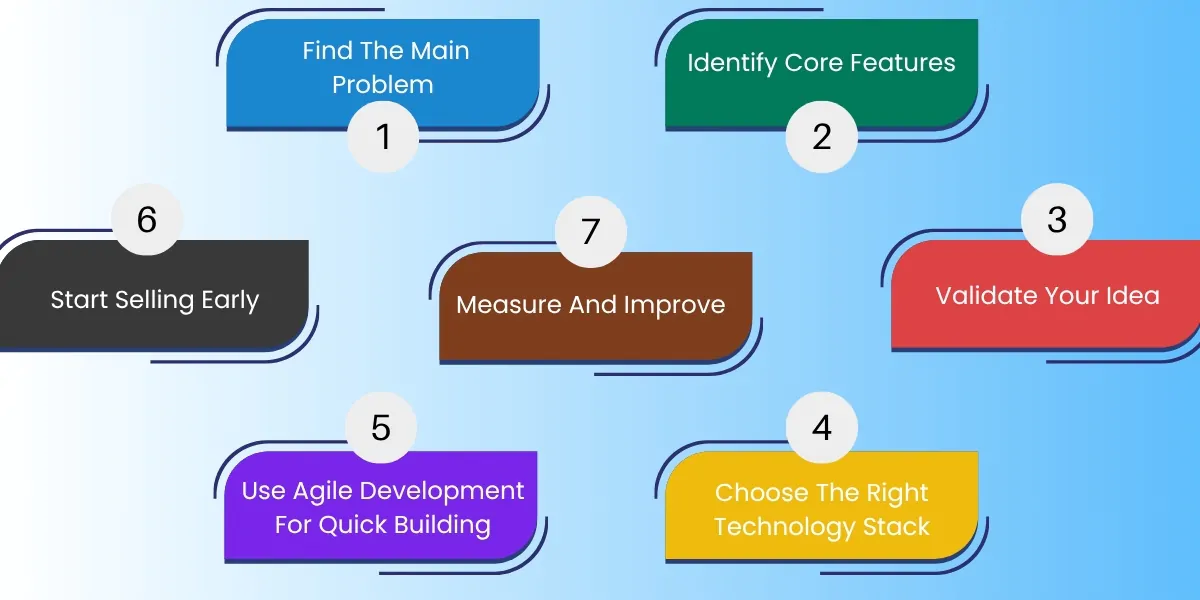
Here is a proven method to efficiently build an MVP:
Step 1: Find The Main Problem
Identify:
- One main problem
- One main group of people to target
Ask:
- What type of problem are you trying to solve?
- Why is this important?
Step 2: Identify Core Features
Make a list of all features to include → then remove seventy to eighty percent.
Keep:
- Must-have features
- Main function
Step 3: Validate Your Idea
Prior to developing the product:
- Do surveys
- Create landing pages
- See if you have Market Demand
Step 4: Choose The Right Technology Stack
Consider:
- Speed
- Scalability
- Costs
Examples:
- Frontend: React/Next.js
- Backend: Node.js/Python
- Cloud Infrastructure
Step 5: Use Agile Development For Quick Building
- Develop quickly
- Have short development iterations
- Get continuous feedback
- Develop iteratively
Step 6: Start Selling Early
- Release your MVP quick!
Goal: Get actual user feedback and start improving your product quickly.
Step 7: Measure And Improve
Record:
- User Engagement
- User Retention
- User Conversion
Then use this data to continuously improve your product.
MVP Development Cost Breakdown
| MVP Type | Estimated Cost Range | Best For | Key Features Included |
|---|---|---|---|
| Basic MVP | $10,000 – $30,000 | Early-stage startups | Core features, simple UI, limited functionality |
| Mid-Level MVP | $30,000 – $80,000 | Growing startups with validation needs | Enhanced features, better UX, basic integrations |
| Advanced MVP | $80,000+ | Funded startups / complex products | Scalable architecture, AI features, full integrations |
How to Reduce MVP Development Cost
- Build only essential features
- Use Open Source Software
- Outsource to Experts
- Avoid over-engineering
- Use Cloud Solutions
Smart planning can reduce costs by 40–60%
Real-World MVP Success Examples
Startup MVP
A startup reached out to a software company with a big plan for a complete software product. Instead of trying to develop this larger product, the software company created an MVP.
Key Items:
- Low-Startup Budget
- High-Competitiveness
- Short-Timeline
MVP Method:
- Build Only What is Needed.
- Agile Development
- Development Completed in Less Than 10 Weeks.
Results:
- Over 50,000 Users in the First 3 Months.
- Got Funding From Investors.
- Over 55% Lower Initial Cost.
This demonstrates how speed + validation are more important than perfection.
Key Benefits of MVP Development
- Get Your Product to Market Faster
- Lower Cost
- Real User Feedback
- Continuous Improvement
- Better Investor Attraction
Alternate MVP Development Strategies
Beyond the Basic MVP Development Process, You May Want To Consider:
AI Integration.
Things such as:
- Recommendation Engine.
- Automated Processes.
- Business Analytics.
API-First Development Strategy
Things such as:
- Easy transition of data to other systems.
- Ability to scale in the future.
Cloud-Native Approach
Things such as:
- Flexibility to pivot.
- Cost-efficient methods of operating.
Why Empirical Edge Provides the Best Software Development Services
Empirical Edge specializes in helping startups build fast, scale efficiently, and reduce costs through smart MVP development.
Ready to turn your idea into a successful product?
Empirical Edge helps startups build fast, cost-effective, and scalable MVPs.
Frequently Asked Questions
The main goal is to validate your idea with minimal cost and effort while gathering real user feedback.
Building an MVP usually takes 6–12 weeks, depending on the complexity, features, and development approach. Simpler MVPs can be launched faster, while more advanced ones with integrations or custom functionalities may take additional time. Using agile methods helps speed up development and ensures faster delivery.
MVP development costs typically range from $10,000 to $80,000+, based on the scope, features, design, and technology used.
Yes, MVPs are built to grow into full-scale products over time. With the right architecture, you can easily add new features, improve performance, and scale as your user base increases.
Empirical Edge provides scalable, cost-effective, and AI-driven MVP development solutions tailored to startup needs. With a focus on fast delivery, modern architecture, and long-term growth, they help startups validate ideas quickly and build a strong foundation for future success.
Written by: Empirical Edge