

When companies expand, it is usually a cause for celebration, as this often indicates success-and-is accompanied by increased customers and orders, plus the potential to expand your business operations. However, companies that have previously used stable technology systems for their business processes may also discover hidden weaknesses with these systems as they continue their growth.
Recently, a growing company located within the U.S. approached our team about their concern, which is something that many businesses deal with but never admit to experiencing.
Initially, the issues that the company was experiencing seemed to be minor in nature – such as slow-loading web pages during peak times; reports not matching each other; etc. However, at times the company was required to utilize some kind of workaround solution to complete an everyday task.
None of these issues is really that serious however they all seemed to make the company feel very fragile. The company’s management team began to question what they will be facing as their company continues to grow.
It really isn’t today’s issues that are of concern but rather the unknown future issues that could arise.
The Unseen Dangers of “Fully Functional” Systems
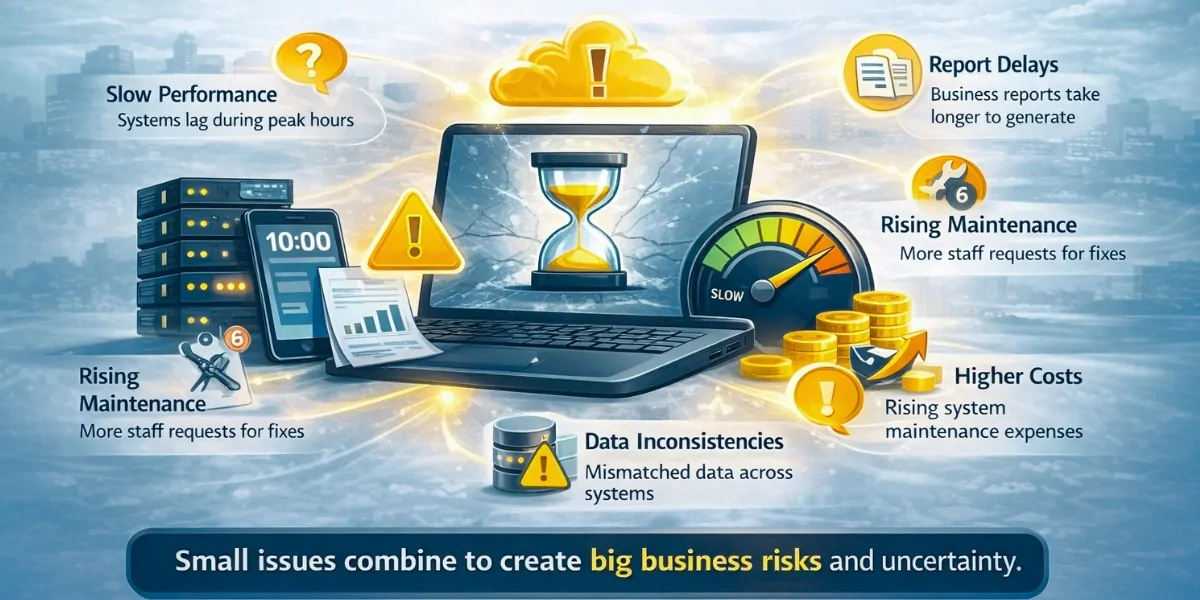
Some businesses believe their software is in good shape as long as the software works, but when the system can’t keep up with normal, everyday usage, then it is rarely able to succeed when the workload increases.
A company had two years of growth, with a sizeable increase in new customers acquired within a relatively short period. As a result, the company had a dramatic increase in daily transactions.
This rapid growth turned a once-reliable and fast transaction processing system into a system that was very unpredictable and slow.
Throughout this time, the company experienced:
- Periodically slow performance within their systems during peak hours
- An increase in the volume of maintenance requests from internal employees
- Data inconsistencies between their various systems
- An increase in the time it takes to create business reports
- An increase in overall system maintenance costs
While these issues by themselves do not appear to be serious concerns, they do create a lot of uncertainty when combined into one issue.
Uncertainty makes it more difficult for businesses to operate efficiently and confidently in their planning and decision-making processes.
Business Risks from Minor Problems
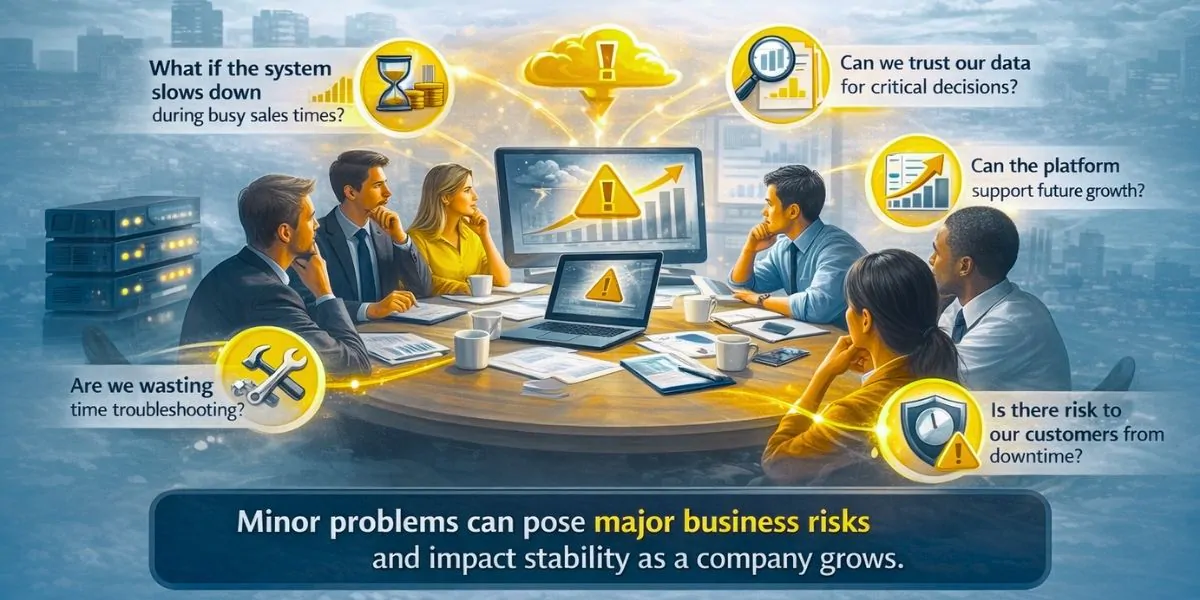
Most issues with technology do not begin as huge failures. Rather, they begin as small inefficiencies and grow into significant risk.
For this organization, the executive team began asking tough questions:
- What is the risk if the system does not perform well (slow down) during busy sales times?
- Can we rely on our data for making critical business decisions?
- What will be the operational capacity for handling future growth on the platform?
- Are we spending more time troubleshooting temporary issues than we should?
- Is there a risk to our customers if there is unexpected downtime?
These questions led to a greater concern about operational stability for this organization.
Growing businesses need a reliable system to grow. If they are not reliable, growing a business can be frustrating rather than exciting for the individual and the organization.
The Cost of Not Knowing
Uncertainty was one of the largest concerns for this organization.
They did not know:
- If their system could scale
- Where their performance bottlenecks were located
- Which components needed improvement
- How much risk they were carrying
- What other problems might arise next
Uncertainty is a barrier to making decisions.
Rather than concentrating on growth initiatives, the leadership was spending time worrying about limitations of the system.
The teams were working in spite of the technical limitations of the system when they should have been finding ways to work more productively.
This has resulted in some hidden costs to the organization that cannot be easily quantified, but are easily visible.
Why Many Companies Encounter This
This problem is more prevalent than most companies understand.
Many companies operate with systems suited to the start up stage of operations; however, with growth there is a continual addition of new functions and integrations.
As a result of the continual addition of new functions, the technology becomes more complex, and therefore more difficult to manage.
Consequently, the original architecture is usually out of alignment with the scale of the business.
However, the system continues operating, resulting in a misconception that the system is operating stably.
Performance issues rely on timeframes that have now changed.
Early Warning Signs That Are Frequently Missed
Most companies only recognize system-based risks after the problems have occurred. However, there are frequently signs that appear much earlier than the sign of a potential problem.
Here are some common signs that would signal the urgency to evaluate the system(s) to determine if they have changed since being implemented:
- An increase in response time of the system.
- Frequent manual workarounds.
- Increasingly effort in maintaining the systems.
- Report time takes longer.
- Data inconsistencies.
- User dissatisfaction.
- Difficulty being able to add more functions to the system.
These signs are typically an indication that the organization should conduct a strategic analysis of its systems.
Earlier is much less expensive to fix than reacting to failure of a system.
Strategic Technology Planning: Why it’s Important
Businesses should use technology to aid growth, rather than hinder it.
When a company has a system which is aligned to its long term goals, the organization is confident enough to scale their operations.
Strategic planning can also help companies:
- Identify risks before they become problems.
- Increase the reliability of their system.
- Minimize technical debt.
- Improve performance.
- Support ongoing growth.
Companies that invest in clarity of strategy will build greater control of their use of technology.
Control leads to confidence.
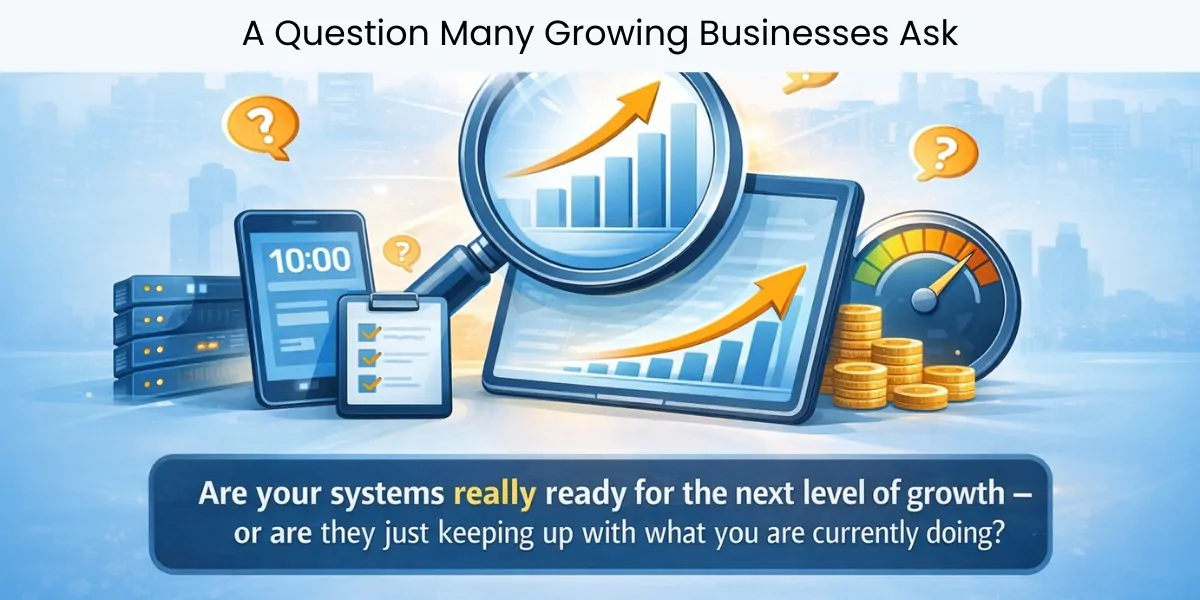
Not sure if your systems are ready for growth?
Empirical Edge Inc. helps businesses identify technology risks and build scalable solutions with confidence.
Frequently Asked Questions
As businesses grow, systems originally designed for smaller workloads may struggle to handle increased demand.
Slow performance, data inconsistencies, manual workarounds, and frequent maintenance are common warning signs.
Stable systems allow businesses to scale confidently without operational disruptions or customer impact.
Strategic planning, system evaluation, and scalable architecture help reduce long-term risks.
Empirical Edge provides strategic technology evaluation and scalable development solutions aligned with business goals.
Written by: Empirical Edge