




Businesses will be under increasing pressure in 2026 to do more with less, i.e. to operate faster, reduce costs, and generate more revenue than ever before. Businesses have also traditionally used workflows that cannot keep up with this pace of change.
AI automation for business is transforming how companies operate and scale.
AI automation is about replacing some aspects of manual work with new, intelligent systems that can learn, reason and perform the task at scale. Companies from startups through large enterprises are using AI to improve their operational efficiency, and thereby allow them to take advantage of new ways to earn revenue.
This guide will help you understand how AI is used in automation, where it provides the most value, and how can your business implement AI in an effective manner.
What is AI Automation in Business?
AI automation uses AI to automate many aspects of your business (e.g., tasks, processes, and decision-making) across all areas of your business.
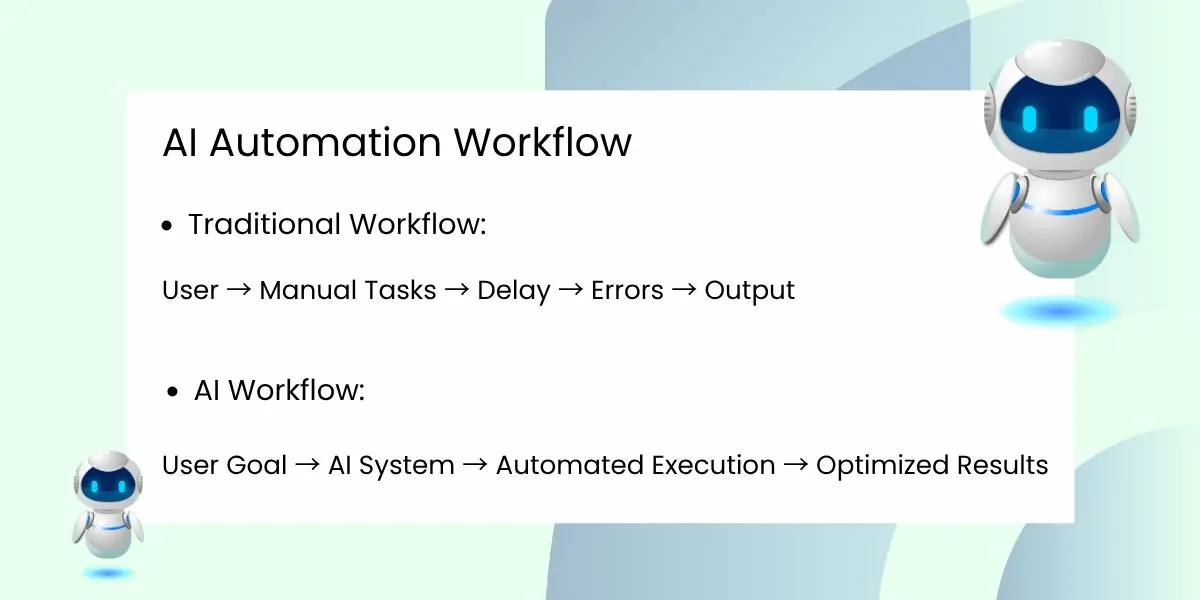
While traditional automation (which uses fixed rules to build automation systems) cannot perform well across disparate locations within a company as easily as AI can:
AI Systems Can:
- Understand context
- Learn from data
- Make decisions in real time
Therefore, AI Systems are much more powerful and can be applied at scale to a variety of industries.
Why Businesses Are Investing in AI Automation
The numbers clearly show the impact:
- Businesses can reduce operational costs by up to 30%
- AI improves productivity by up to 40%
- AI-powered lead generation can increase sales by 50%
- Many companies achieve ROI within 6–12 months
- Every $1 invested in AI can return $3.70 or more
These are not future predictions—these are real, measurable outcomes.
How AI Automation Saves Time and Improves Efficiency
Automation of Repetitive Tasks with AI Saves You Time
Automating data entry, report generation, and responding to emails are examples of the manual processes that AI (artificial intelligence) can eliminate. For example, AI can reduce the amount of time you spend on document processing by up to 90% and also save you money.
Faster Decision Making
AI can analyze large amounts of data in seconds to help companies make quick, timely, and accurate decisions.
Round-the-Clock Operations
AI can operate continuously. Companies can use AI for customer service, monitoring, and processing services.
How AI Automation Increases Revenue for Businesses
Increased Sales and Leads
AI can help improve sales and leads by analyzing customer behavior, personalizing offers for customers, and automating follow-ups after a customer clicks on an ad.
Results: More customers to buy and the higher sales because more leads are converted into sales.
Smarter Marketing
Ad targeting, content creation, and measuring campaign performance can be improved with AI.
Therefore, companies that have implemented AI in their marketing and sales have seen revenue increases of as much as 79%.
Exceptional Customer Experience with AI
AI can help improve customer experience with chatbots, personalized recommendations, and faster customer support; thus, improving retention and increasing lifetime value.
Examples of AI Automation in the Real World
1. Automating Customer Support
Chatbots use AI to automate up to 80% of common inquiries from customers. AI improves response time and decreases volume of requests handled by customer service agents.
2. Automating Finance and Accounting
AI can automate:
- Processing invoices
- Tracking expenses
- Detecting fraud
An example of automation in finance is that some companies can reduce the cost of processing invoices by more than 90%.
3. Automating Sales
AI assists in:
- Recognizing leads
- Setting up follow up meetings
- Forecasting customer behavior
Using Artificial Intelligence, companies are experiencing their cycles to complete sales are much shorter than previously and they have increased revenue due to this reduction.
4. Automating Recruiting
AI can help Automate:
- Resume screening
- Scheduling Interviews
- Creating Onboarding Processes
In most instances, companies have reduced the time needed to hire employees by up to 90%.
5. Automating Software Development
AI assists with:
- Writing code
- Testing code
- Deploying code
By utilizing automation within their coding practices, developers are developing at a much quicker pace and more efficiently.
The Challenges with AI Automation
AI Automation is powerful but not plug-and-play.
Typical impediments to AI automation include:
- Poor implementation strategy
- Lack of skilled workers
- Integration with existing systems
- Data privacy issues
Many companies fail by adopting AI tools without redesigning workflows.
How to Implement AI Automation Successfully
Step 1 – Identify Bottlenecks
Focus on repetitive, high time-consuming tasks
Step 2 – Start Small
Select one use case (for example: customer service)
Step 3 – Use the Right Tools
Select an AI solution that is appropriate for your business.
Step 4 – Integrate with Current Systems
Make sure the workflows integrate smoothly.
Step 5 – Increase Gradually
Grow the automation from which department
Case Study: AI Automation Success
a rapidly growing SaaS company:
- Slow operations.
- High volume of manual work
- Low productivity
- Solution
Implementing AI automation for:
- Customer services
- Data processing.
- Managing workflows.
Results
- 60% reduction in manual work.
- 3 times faster operations.
- Substantial revenue increase.
This is a clear example of how AI Automation can have a positive impact on business performance.
Final Thoughts
AI automation is no longer optional—it’s a competitive necessity.
Businesses that adopt AI strategically can:
- Save time
- Reduce costs
- Increase revenue
- Scale faster
The key is not just adopting AI—but implementing it correctly.
Ready to Transform Your Business with AI?
Don’t let manual processes slow your growth. Empirical Edge helps you build intelligent, scalable solutions that save time and increase revenue.
Frequently Asked Questions
AI automation uses artificial intelligence to automate tasks, processes, and decision-making, improving efficiency and reducing manual work.
AI improves sales, marketing, and customer experience, leading to higher conversions and better customer retention.
Examples include chatbots, automated data processing, AI-driven marketing, and workflow automation systems.
Costs vary, but many businesses achieve ROI within 6–12 months due to efficiency and cost savings.
Industries like healthcare, finance, retail, SaaS, and eCommerce benefit significantly from AI automation.
Written by: Empirical Edge