



By 2026, most companies are no longer using AI just for experimentation, but instead are creating entire organizational structures around it. LLMs and generative AI are already transforming how organizations operate, innovate, and grow.
Using generative AI as part of workflows to create content, generate code, or produce meaningful insights is quickly becoming a standard part of software development.
Adopting this technology will position companies for a competitive advantage through reducing costs, increasing efficiencies, and creating new revenue opportunities.
This guide will explore the mechanics of developing generative AI solutions and LLMs; identify where the most value can be created; and provide an overview of how to successfully realize value from their implementation.
What Is Generative AI and LLM Development for Businesses?
Generative AI refers to sophisticated machine-learning algorithms that produce new types of content, including text, image, code, and data.
LLMs represent one type of generative AI that have been specifically developed to process, comprehend, and produce language similar to that of a human being.
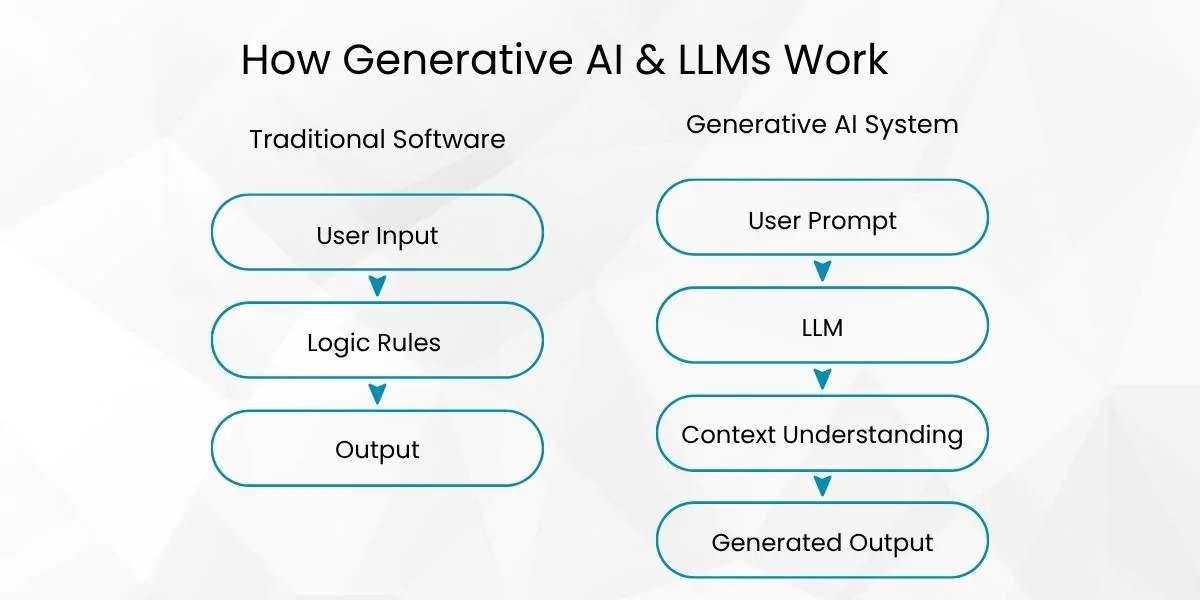
Unlike traditional software, these applications and systems are designed to:
- Interpret natural language and respond accurately
- Learn from large datasets to generate context in real time
- Produce responses based on prior inputs
These capabilities make these types of technologies very suitable for building AI-based applications and automation systems.
Why Businesses Are Investing in Generative AI in 2026
The adoption of generative AI is growing rapidly across industries.
- 89% of enterprises use AI for content creation
- 78% use AI for code generation
- 73% use AI for customer support automation
Businesses are seeing:
- Higher productivity
- Faster decision-making
- Reduced operational costs
Generative AI is expected to generate trillions in economic value globally in the coming years.
Key Technologies Behind LLM Development
LLMs rely on advanced technologies that enable them to understand, generate, and act on human language at scale. LLMs can utilize these core technologies (which form the foundation of most modern AI systems and intelligent automation) to create highly sophisticated applications that can help businesses in multiple ways.
Transformers
Transformers are the framework for all modern-day A.I. models. They allow systems to compute and capture context when processing and understanding all types of natural language requests through the recognition of relationships between word orders in a sentence. The use of transformers or transformer architecture allows the LLM models to generate responses that are incredibly accurate and virtually indistinguishable from human participants.
Benefits:
- Able to capture the context and meaning (not simply the keywords) of the request.
- Enables the LLM to create naturally flowing conversations with people.
- Transforms existing applications into fully functioning chatbots, creates content for the Internet and assists with the development of code.
- Provides scale to large datasets.
RAG – Retrieval-Augmented Generation
Retrieval-Augmented Generation (RAG) is a technology that enhances any LLM by creating a system capable of combining existing pre-trained data with real-time retrieval capabilities for all enterprise or cloud-based system. RAG allows you to retrieve relevant information in real-time, instead of relying solely on LLM training data, while producing the correct content from other databases or documents.
Benefits:
- Provides real-time up-to-date responses to the user’s request.
- Improves the overall accuracy of the results produced by the LLM when used for business-critical applications.
- Greatly reduces the number of hallucinations within the generated AI output.
- Simply put, RAG technology is one of the most effective ways for enterprises to build knowledge-based systems and search query engines.
Fine-Tuning (Customization for Business Needs)
Fine-tuning can help businesses customize their AI models and enhance them by adding domain-specific datasets, enabling them to improve their understanding of how their customers use or refer to their products, and how their users want to be treated while using those products, ultimately making these LLMs fully functional.
Benefits of Fine-Tuning:
- Tailored responses based on your customers and industry
- Improved accuracy / relevance
- Improved alignment with your business goals / objectives
- Improved user experience
AI Agents (Autonomous Systems)
By using AI agents, businesses are now moving into the next generation of automation, which will allow for autonomous systems that can make decisions, create workflows, execute tasks, and carry out instructions without requiring ongoing manual interaction.
Benefits of AI Agents:
- Ability to automate a complete workflow (end-to-end)
- Can be integrated with various APIs, tools, or databases
- Ability to use intelligent decision-making processes
- Ability to scale operations without increasing manpower or resources
Why This Technology is Important
By combining the two primary technologies, these technologies create a powerful ecosystem that will provide industries and businesses with highly efficient and scalable automated solutions.
Impact on Business:
- Faster operational processes & less manual labor required
- Improved decision-making based on real-time data collection
- Better customer experience when interacting with companies
- Increased productivity and revenue growth when compared to pre-automation levels)
Generative AI Applications of Real World ROI
Generative AI is providing real ROI today across many verticals.
1. Customer Support
Businesses are using LLMs to automate the following customer support functions:
- Answering customer queries
- Resolving customer tickets
- Providing 24/7 customer support
AI can automate up to 80% of the customer queries a business receives.
2. Content & Marketing
AI is also capable of generating content for businesses, including:
- Blogs
- Advertising copy
- Product descriptions
By using AI-generated content, businesses can produce content more quickly and improve their overall rate of engagement.
3. Software Development
There are a variety of AI software developer tools that assist developers with:
- Writing code
- Debugging
- Automating test procedures
Businesses can provide faster development cycle times using AI.
4. Internal Knowledge Systems
AI can help organizations:
- Search for business data
- Answer employee questions
- Increase decision-making accuracy
Internal knowledge systems are likely to provide organizations with some of the highest ROI of AI solutions available on the market today.
5. Business Processes
AI can automate many businesses’ workflow processes, including:
- Document processing
- Data analysis
- Business process execution
Businesses leverage AI to to decrease labor-intensive tasks and create a more efficient way of doing business.
Case Study: Generative AI in Action
A large company utilized generative AI to assist them in the automation of internal workflows and decision-making processes.
Challenges
- Reliance on traditional, slow, manual processes
- Multiple systems with data that was not easily accessible
- Long, delayed decision-making processes
Solution
- Create a knowledge assistant powered by LLM
- Integrate artificial intelligence across the various workflows
- Automate reporting and data analysis functions
Results
- Faster decision-making
- Enhanced operational efficiency
- Reduction in the amount of manual work completed
Many organizations are already using generative AI in their reporting, forecasting, and automation functions across departments are numerous!
The Advantages of Generative AI and LLM Development
1. Greater Productivity
Automation processes of repetitive tasks results in accelerated workflows.
2. Cost Reduction
As a result of less manual work, companies typically have lower operational costs.
3. Faster Innovation
Through utilizing AI, businesses will be able to develop and bring products to market more quickly.
4. Scalability
AI has the ability to perform thousands of tasks at one time.
5. Enhanced Decision-Making
Real-time data analysis creates real-time insights for decision-makers.
Challenges in Generative AI Development
Even though there are many advantages of AI and its growing demand, there are several challenges in adopting it successfully, including:
Data Quality Problems
If poor data is used, inaccurate results will be produced.
Complexity of Integration
AI must integrate with existing systems.
Security and Compliance Issues
If sensitive data is being used, it must be protected.
Availability of Skills
Most companies currently do not have employees with the expertise to develop AI.
Many AI projects never get further than pilot programs and do not progress into production.
How to Implement Generative AI Effectively
Stage 1: Determine Use Cases
Choose use cases with high potential for automated or customer support.
Stage 2: Choose the Right Model
Select LLMs based on your specific business needs.
Stage 3: Create Data Pipelines
Ensure your data is organized and clean, and able to be used easily.
Stage 4: Create and Integrate Models
Integrate the AI model into your existing systems.
Stage 5: Monitor and Improve Models
Keep monitoring model performance to ensure continued success.
Ready to Build Intelligent AI Solutions for Your Business?
Unlock the power of Generative AI and LLM development to automate workflows, improve efficiency, and drive growth.
Frequently Asked Questions
Generative AI development involves building systems that can create content, automate workflows, and generate insights using AI models like LLMs.
LLMs are used for customer support, content generation, data analysis, automation, and building AI-driven applications.
Costs vary depending on complexity, but businesses often see high ROI due to automation and efficiency gains.
Industries include healthcare, finance, SaaS, eCommerce, education, and manufacturing.
It typically takes 6–16 weeks depending on features, integrations, and complexity.
Written by: Empirical Edge