
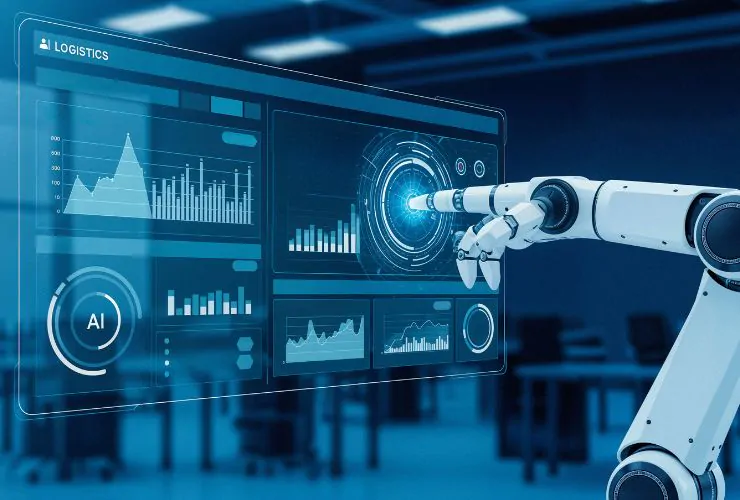



Many businesses are creating massive amounts of information every second in our modern digital society. Unfortunately, unless these businesses execute the analysis of the data appropriately, it won’t serve any useful purpose. With the advent of Machine Learning (ML) and Predictive Analytics, A company’s ability to properly analyze data and derive value improves significantly, resulting in greater efficiency, faster response times, and higher accuracy.
Machine Learning enables systems to learn from data and continuously improve performance without explicit programming. Predictive Analytics uses insights generated by Machine Learning models to forecast future outcomes based on historical and real-time data.
In combination, ML and Predictive Analytics provide an organization with the ability to create better, faster and more accurate decisions.
What is Machine Learning (ML) in Artificial Intelligence?
Basically, Machine Learning (ML) is a form of Artificial Intelligence (AI), designed to allow a system to discover patterns in its data without having been pre-programmed to discover specific patterns.
Unlike a traditional computer program that can only follow a predetermined rule set, a ML model can develop freely based on how much access it has to new datasets.
Key functions of Machine Learning:
- Detecting underlying patterns in massive amounts of data.
- Improving predictive accuracy based on new datasets.
- Automating certain types of decision making, i.e., automated decision-making systems.
- Providing the intelligence to operate AI-based technologies such as chatbots and recommendation engines.
What is Predictive Analytics?
Predictive Analytics involves taking historical trend/pattern data, statistical analysis, and using ML algorithms to anticipate future events based upon previous events that fall under the same historical patterns and data trends.
According to historical research, using Predictive Analytics provides organizations with reliable projections on what is occurring today, as well as what will happen in the future, based upon the history of past trend/pattern behavior.
Common applications of Predictive Analytics:
- Sales Forecasting
- Customer Behavior Forecasting
- Risk Management
- Fraud Detection
- Demand Forecasting
Machine Learning (ML) drives predictive analytics by analyzing massive amounts of data to create models that are continually refined to enhance the accuracy of predictions.
Some examples of how this is accomplished include:
Banks can utilize ML to develop models that accurately predict if someone will default on a loan. Retail stores can predict how much of a specific product they can expect to sell during a given time period. Health care systems can predict the likelihood that a patient will develop a particular disease. Marketing departments can predict how many customers are likely to stop using their services in the near future.
Predictive systems utilizing ML can identify patterns and use them to create actionable insights for companies.
Benefits of ML & Predictive Analytics
1. Improved decision making
Companies can use real-time data to make facts-based decisions, rather than guesswork.
2. Enhanced customer engagement
Predictive analytics provides personalized recommendations to customers when making purchases and assists in developing marketing campaigns.
3. Risk management
Detect early warning signs of fraud, financial uncertainty, and operational inefficiencies.
4. Increased productivity
Increased productivity through automation and reduced manual data analysis
5. Increased revenue
Companies can improve sales and inventory by producing accurate sales forecasts.
Examples of real-world applications
1. E-commerce
Predict customer preferences before they happen and recommend products to purchase based on their history of purchases.
2. Banking and finance
Identify potential fraudulent behavior and assess credit risk prior to lending money.
3. Healthcare
Predict the likelihood that patients will have good or poor outcomes and which patients are likely to develop serious conditions.
4. Service and manufacturing
Use predictive analytics to identify when equipment is likely to fail and plan maintenance activities accordingly to minimize downtime.
5. Marketing
Determine which customers are likely to respond positively to a campaign and target them based on previous campaign targeting.
Machine Learning vs Predictive Analytics
| Feature | Machine Learning | Predictive Analytics |
|---|---|---|
| Purpose | Learns from data | Forecasts outcomes |
| Approach | Algorithm-based learning | Statistical + ML models |
| Output | Patterns & models | Future predictions |
| Dependency | Data-driven | ML + historical data |
Future of ML & Predictive Analytics
By 2026 and beyond, many businesses will be increasingly dependent on the following technologies.
- AI-powered automation
- Real-time Predictive Systems
- Generative AI integration
- Hyper-Personalized Analytics
The competitive advantage gained will be strong for those organizations adopting these technologies sooner than later.
Insight Expanded
The sheer growth of data continues to build to an exponential level. As it does, the future of Machine Learning (ML) and Predictive Analytics will be changing from reactive analysis to fully autonomous decision-making systems. Companies will no longer only analyze what has happened; they will have real-time visibility into the present and predict what will happen next with accuracy.
AI-Powered Automation will streamline complex workflows and reduce manual effort in all areas of finance, healthcare, retail and manufacturing.
Real-Time Predictive Systems will create instant decision-making around things like dynamic pricing in e-commerce, fraud detection in banking, and predictive maintenance in an industrial setting.
Predictive Models Using Generative AI have the ability to not only predict outcomes, but also to automatically create actionable strategies, content, and solutions.
Hyper-Personalization will change how we provide services to our customers and create targeted recommendations based on the behavior of our customers.

Final Thoughts
Machine Learning and Predictive Analytics are no longer optional—they are essential for modern business success. Companies that leverage these technologies can predict trends, reduce risks, and make smarter decisions faster than competitors.
Ready to transform your business with AI-powered insights?
Partner with Empirical Edge and build intelligent data-driven solutions today.
Frequently Asked Questions
Machine Learning is a branch of AI that allows systems to learn from data, identify patterns, and improve decisions without being explicitly programmed.
Predictive Analytics is used to forecast future outcomes such as sales trends, customer behavior, risk levels, and operational performance using historical data.
Machine Learning powers Predictive Analytics by analyzing large datasets, identifying patterns, and continuously improving the accuracy of predictions.
Industries like healthcare, finance, retail, manufacturing, and marketing benefit greatly by improving decision-making, efficiency, and forecasting accuracy.
Key benefits include better decision-making, improved customer experience, fraud detection, risk reduction, and increased business efficiency.
Written by: Empirical Edge