Software is a key part of business success for companies today as it allows companies to run their business processes, interact with customers, analyze data, automate processes, and grow over time. Companies need one comprehensive software solution rather than relying on multiple independent solutions with no integration and no guarantee of performance.
Empirical Edge Inc. develops and delivers custom-built software solutions that will grow with a company’s needs, solve their business issues and make the company more competitive.
What Are End-to-End Services?
End-to-End Services are a set of services that cover the creation of an application’s complete life cycle from the time it is first conceived until it has been fully developed, tested, deployed, and maintained after launch.
By utilizing only one standard development provider, these services provide an organization with a single vendor to work with for the entire life cycle of the development of their application.
Some examples of end-to-end services include:
- Conducting business analysis and requirements definition,
- Designing the system architecture,
- Developing custom software applications,
- Building the cloud and back-end portion of the application,
- Conducting quality assurance and testing, and developing the DevOps process for the entire application,
- Deploying and implementing the application,
- Maintaining, supporting, and providing for the future growth and expansion of the application.
Empirical Edge provides the above services with an emphasis on their overall performance, security, user interface, and anticipated long-term viability of the application.
Why Enterprises Need End-to-End Development
Large organizations face unique challenges that require holistic solutions:
1. Complex Workloads and Verticals
Enterprises often need multiple systems — from CRM and ERP to analytics dashboards and customer portals — that must communicate seamlessly.
2. Data Security & Compliance
With growing regulatory requirements, securing software at every layer is imperative for protecting customer and business data.
3. Integration with Legacy Systems
Most enterprises have legacy platforms that still deliver business value. A comprehensive development strategy ensures new systems integrate smoothly without disruption.
4. Performance at Scale
Enterprise solutions must handle high user volumes, significant data loads, and seamless uptime even during peak usage.
Whether your enterprise is undergoing digital transformation, upgrading legacy applications, or launching new platforms, end-to-end development provides the strategic and technical leadership needed for success.
Explaining the End to End Development Process
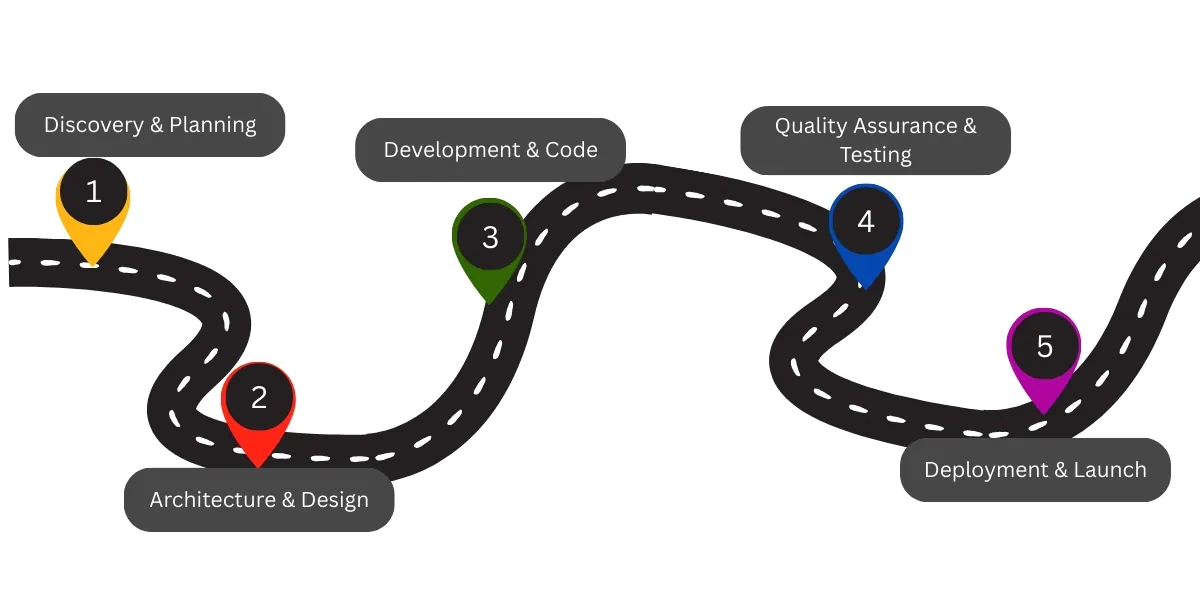
By using a structured, phased methodology throughout the entire development cycle, you can ensure quality, collaboration and a focus on your overall business objectives.
Phase One: Discovery & Planning
The first phase in the overall development cycle, where you will:
- Identify business objectives
- Identify user requirements
- Identify system requirements
- Identify success metrics and KPI’s
As a deliverable, you will create a defined roadmap that aligns technology to your strategic objectives.
Phase Two: Architecture & Design
Once the scope has been defined, the architects will design:
- Scalable architecture
- UX/UI Design
- Database and integration designs
- Security and compliance requirements
A strong architecture provides a low risk and high performance platform.
Phase Three: Development & Code
This phase will bring your solution:
- Back End Services
- Front End Interfaces
- API Integrations
- Cloud Infrastructure
The developers use the latest best practices to ensure the quality of the code using modern frameworks, such as React, Node.js, .NET Core, and cloud platforms (AWS/Azure).
Phase Four: Quality Assurance & Testing
Comprehensive testing for issues early:
- Functional Testing
- Load and Performance Testing
- Security Testing
- Regression Testing
- User Acceptance Testing
Testing ensures the software will perform as expected in the “real world”
Phase Five: Deployment & Launch
From staging to live environments the deployment process includes:
- Continuous Integration / Continuous Delivery (CI/CD) Pipelines
- Infrastructure Provisioning
- Data Migration
- Feature Release Planning
The deployment process allows for minimal downtime and continued operations.
Advantages of Software Development from start to finish
Less Vendor Management Effort
Only one Vendor from start to Finish for Planning through Support creates less co-ordination overhead.
Consistent Quality Standards
Utilizing the same development practices & standards will ensure higher reliability.
Faster Time to Market
With teams aligned (e.g. development and quality assurance) and clear roadmaps for projects, those projects can typically be delivered per their timelines.
Improved Security & Compliance
Having built in security protocols will reduce vulnerabilities and enhance readiness for compliance with regulations.
Future-Ready Architecture
Your application will be able to scale as needed, and be modular for upgrades, and will be ready for integration with new technologies such as Artificial Intelligence (AI), Internet of Things (IoT), analytics pipelines, and automation.
Cost Savings
A corporate information technology ecosystem can be designed and put in place so that the result will significantly reduce your longer-term technical debt and maintenance costs.
Typical Applications by Enterprise
This is how the enterprise benefits from full cycle development:
- Enterprise Resource Planning (ERP) Systems: Centralized platform for managing finance, human resources, operations, and reporting.
- Customer Relationship Management (CRM): Centralized records of customer interactions and resulting analytics.
- Supply Chain and Logistics Management: Real-time inventory management and distribution tracking.
- Custom Business Portals: Self-service systems for employees and partner portals.
- Data Analytics and Business Intelligence Dashboards: Making smarter decisions through improved access to data.
- Mobile and Web Applications: Customer-facing applications that can adapt and grow with business demands.
Each application developed will work as intended, be reliable, and will allow for the development of the future versions of that application.
Future Enterprise Software Trends
There are several Future Trends that Enterprises Should Pay Close Attention to:
- AI & Machine Learning for Predictive Analytics
- Microservices & API First Architecture for Modular Development
- Serverless & Cloud-Native Solutions for Flexibility
- Edge Computing for Real-Time Processing
- Hyper-Personalization in the Customer Experience.
Building a Future Ready Business will Keep Your Enterprise Strong as Long as Change is a Constant.
Ready to build enterprise software that drives growth and innovation?
Partner with experienced professionals to develop secure, scalable, and future-ready solutions tailored to your business goals.
Frequently Asked Questions
They cover the entire software lifecycle, including planning, design, development, testing, deployment, and post-launch maintenance.
Enterprises benefit from unified project management, consistent quality standards, faster delivery, and reduced operational risk.
Solutions are architected with future growth in mind, using modular design, cloud infrastructure, and performance optimization.
Common technologies include cloud platforms (AWS, Azure), modern frameworks (React, .NET, Node.js), DevOps tools, and secure database systems.
Written by: Empirical Edge Team