



The modern-day software industry is one of the biggest engines behind the success of the world’s economy, providing the backbone for every type of business—ranging from startups to large corporations. Developing successful software, however, is not an easy feat. It consists of many intricate systems, rapidly changing technology, and continually increasing user expectations.
As such, both long-established enterprises that create large applications and brand new startups that create Minimum Viable Products (MVPs) will run into obstacles during development that can have an impact on cost, timeline, and performance.
Despite sufficient planning—clear requirements, an organized architectural structure, and scalable strategies—numerous software projects still do not achieve success. The most frequent reasons for this include lack of clarity in the requirements phase, constant changes in requirements during development, and inadequate resources or developer capacity.
This guide discusses the top software development challenges and gives you practical solutions and real-world examples to help you build successful and scalable applications.
Why Software Development Projects Fail
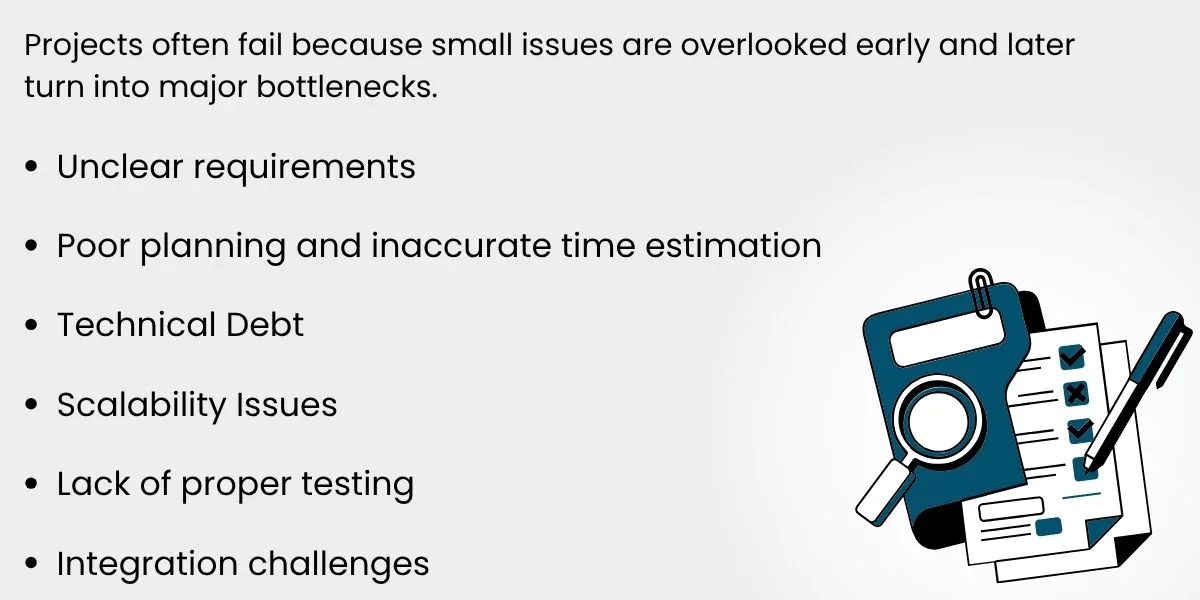
Modern software development is not just about writing code—it’s about managing complexity. Projects often fail because small issues are overlooked early and later turn into major bottlenecks.
Without proper planning, communication, and scalability strategies, even minor inefficiencies can lead to delays, increased costs, and poor user experiences.
Unclear requirements are one of the most common challenges in software development.
Common difficulties encountered in software development are ambiguous/unclear requirements. When business objectives aren’t well defined, teams struggle to align their work effectively of work into alignment and requirements change during the project. This results in project delays, increased cost, and miscommunication amongst teams. The simplest way to address this issue is to embrace an agile development process, implement smaller incremental delivery of work, and establish constant communication with stakeholders. Collaborating on requirements via wireframes or prototypes as early as possible in the development process also helps ensure alignment on the expectations for deliverable success. For example, a startup delivered 40% more to clients in the initial launch of a product after adopting agile techniques and implementing weekly planning cycles.
Poor planning and inaccurate time estimation
Another common issue faced in software development is ineffective planning and inaccurate time estimation of effort required to accomplish the required work. When project teams fail to accurately estimate their time or effort required to complete a given project, projects tend to run late and engineers typically experience unnecessary levels of stress, resulting in a decline in the quality of the final product. By breaking down tasks into smaller units of delivery, implementing credible project management tools, and using historical data from previous projects, project teams can dramatically increase their ability to properly plan their project time frames. Companies that employ structured planning methodologies have seen delays reduced by more than 30%.
Technical Debt
Errors build over time as a result of developers cutting corners in order to meet deadlines, and this creates a large amount of technical debt that eventually slows down development and creates messy code and more bugs. As time goes on, bad coding practices, high bug rates, and slow feature release cycles will only compound this issue and create even larger technical debt problems that will need to be addressed. In order to reduce technical debt, developers must establish clean coding standards, continuously refactor code, and automate their testing. For example, one fintech found that the majority of their bugs had been eliminated after they focused on improving the quality of their code.
Scalability Issues in Software Development
Many applications face scalability issues because they are not built with growth in mind. As the user base increases, these applications struggle to handle higher demand, leading to slow performance or even complete system failure. To help alleviate the impact that scalability has on application performance, developers should implement modern architectures (e.g., microservices) and use cloud platforms such as AWS, Azure, and GCP. Load balancing and caching will also play an important role in creating scalable applications. For example, an by moving to a cloud-based infrastructure.
Lack of proper testing
Another problem that many applications face is the lack of adequate testing, which can have serious ramifications when bugs reach production, there is making it difficult to detect security vulnerabilities, and the user experience will suffer greatly. In order to mitigate these types of problems, it is important for developers to implement automated testing, utilize CI/CD pipelines, and perform load testing.
Integration challenges
New technology relies heavily on the use of APIs (Application Programming Interfaces) and Third-Party Services (TPPs); Therefore, there are many integration challenges that arise. Poor Integrations may cause Systems to fail or produce inconsistent data. Develop systems using an API-first approach, allowing for proper Error Handling and Testing of Integrations prior to having a complete Integration will allow for smoother workflows.
Security Risks in Modern Software Development
Security Challenges are also critical to take into consideration. Poor security can lead to Data Breaches, Loss of Revenue, and Damage to an Organization’s Reputation. Utilizing DevSecOps Methods of Working, ensure encryption and secure development practices and ensuring that adequate Security Audits are performed on a regular basis are critical to building secure applications.
Case Study of Real World Challenges
A startup company growing rapidly by providing SaaS services. The company was experiencing issues with regular outages; slow application performance; and any real ability to scale as their number of users increased. These issues were hindering their customers’ experiences; as well as preventing their growth as a company.
To solve these challenges the company migrated to a cloud infrastructure, implemented a microservices architecture, and established a comprehensive caching strategy with a load balancing solution.
The outcome of these implementations produced a 70% increase in application performance; tripling in the number of users; and reduced system downtime by 50%. This case study demonstrates how important it is to plan for future scalability from the start.
Best Practices for Building Software
Successful software development requires a balance of approaches to achieve this. Agile methodologies are necessary for maintaining flexibility and encouraging continuous improvement. In addition, using the most current technology (cloud; APIs; and microservices) will help you achieve scalability & efficiency.
Always consider user experience in your projects because it directly affects user retention and continued usage. Prioritize testing as a critical step to identify and fix issues before launching your product. Finally, your architecture should always be able to grow with the demands placed on it so that performance issues do not arise as you grow.
Why Choose Empirical Edge
Empirical Edge specializes in building high-performance, scalable software solutions tailored to modern business needs. With expertise in custom development, cloud architecture, DevOps, and AI-driven systems, the team focuses on delivering solutions that are both efficient and future-ready.

Final Thoughts
Most software development challenges stem from poor planning, lack of communication, and ignoring scalability. The key to success lies in addressing these issues early and adopting modern development practices.
With the right strategy, tools, and expertise, businesses can overcome these challenges and build software that is reliable, scalable, and ready for the future.
Empirical Edge can help you design, develop, and scale high-performance software tailored to your business goals.
Frequently Asked Questions
The most common software development challenges include unclear requirements, poor planning, communication gaps, technical debt, scalability issues, lack of testing, integration problems, and security risks. These issues can lead to delays, increased costs, and poor application performance if not handled properly.
Software development projects often fail due to unclear goals, changing requirements (scope creep), poor communication, and lack of proper planning. In many cases, teams also fail to consider scalability and testing, which leads to performance issues after launch.
Businesses can overcome software development challenges by adopting Agile methodologies, improving communication, using modern technologies like cloud and microservices, and investing in proper testing and planning. Working with experienced development teams also helps reduce risks.
Technical debt refers to the long-term problems caused by taking shortcuts in coding or development. While it may speed up initial development, it results in poor code quality, more bugs, and higher maintenance costs over time.
Testing is critical because it helps identify bugs, security issues, and performance problems before the software is released. Proper testing ensures a stable, secure, and high-quality user experience.
Written by: Empirical Edge