


The explosive growth of the eCommerce industry means that companies must have a dependable, scalable, and secure platform available to support changing user needs. As one of the most commonly used frameworks for PHP development, Laravel is regarded as a highly effective choice for developing contemporary ecommerce software applications due to its flexibility, security, and a wide range of useful built-in features. Laravel has everything needed to implement smooth shopping experiences for both small businesses that build single eCommerce retailers and organizations that develop very large-scale, multi-vendor marketplaces.
In this article, we will discuss why Laravel is the premier option for building eCommerce applications, as well as the fundamental capabilities that should be included in your eCommerce development project and best practice methods for creating high-performance ecommerce stores.
Why is Laravel the Best Choice for E-Commerce?
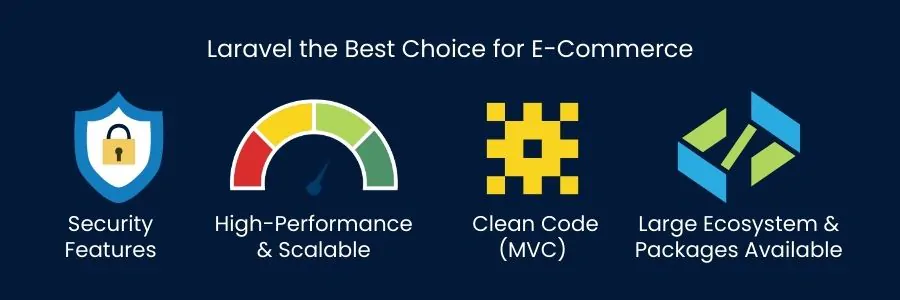
1- Security Features
Security is of utmost importance in e-commerce due to the protection of sensitive customer information (credit card information), transaction information (payment processing), and personal information. What does Laravel have to offer? Built-in Security features (CSRF, password hashing, encryptions, SQL injection prevention), which ensures that e-commerce stores are protected from cyber-attacks.
2- High-Performance & Scalable
All e-commerce websites have to deal with increased website traffic, peak traffic during a sale, and increased seasonal demand for products. Laravel has caching capabilities, queue systems, and Optimized Performance Tools that allow an e-commerce store to be developed as a High-Performance and Scalable website with the ability to handle heavy traffic without any load time.
3- Clean Code (MVC)
Laravel was designed using the MVC structure (Model-View-Controller), which allows the developer to have a structured and organized way of writing clean and easy to maintain code. Because of this structure, it makes it easier to build out an e-commerce store, add new features, and maintain the long-term performance of the store.
4- Large Ecosystem & Packages Available
Laravel has a robust ecosystem and offers many packages to help developers. Some of the most widely used packages in e-commerce include: Laravel Cashier, Laravel Socialite, Laravel Breeze, Laravel Sanctum, etc. These packages save the developer time and provide many out-of-the-box solutions that aid in the development of an e-commerce store like Bagisto, Aimeos, and Laravel Shopping Cart.
Key Features of an E-Commerce Store Powered by Laravel
In today’s digital economy, an effective eCommerce store must contain many features that are designed to assist in maximising conversion rates, security and the overall user experience. Below are a number of important components that any Laravel-based eCommerce store should have:
1) A well-organised and Intuitive Product Catalogue
The structure of a product catalogue is essential to helping consumers locate the items that they are looking for. Laravel’s Eloquent ORM provides fast and effective database interaction via powerful features like filtering, sorting, search box and categories and category hierarchies; these features ensure a great product browsing experience within your eCommerce store.
2) User Authentication that is Safe and Secure
Laravel provides built-in user authentication scaffolding to help facilitate user registration, login, password resets and profile management. User authentication must be quick, safe and trustworthy for eCommerce sites, particularly for customers that store payment details or personal information.
3) A Functional Shopping Cart System
The functionality of a shopping cart is integral to any eCommerce website. Laravel’s shopping cart offerings allow for:
- the addition of/removal of products from/into the cart
- changes to the number of items of each product in the cart
- the ability to save a cart as a favourite for later purchase
- the application of discount codes, coupons, and promotions
Additionally, Laravel provides consistent session management to keep the cart safe and consistent.
4) Payment Processing and Checkout Integration
The checkout and payment processing must always be quick and easy to use. Laravel provides great integration options for several popular eCommerce payment processing services, including:
- Stripe
- PayPal
- RazorPay
- Authorize.Net
- Square
A properly designed administrative console makes it easier for staff to manage orders, inventory levels, customer information and product listings. The Laravel platform has everything needed to create custom dashboards that offer functionality such as:
5) Real Time Order Tracking
- Inventory Automation
- Sales Reports
- Customer Activity Logs
6) Multilingual and Multi-Currency Support
Laravel makes it easy to support multiple currencies, based pricing (where products are sold with pricing based on the country), multi-lingual content, localization. This makes it easier for your customers to interact with you and makes it more likely that they will become repeat customers in the international marketplace.
7) SEO-Friendly Architecture
As a platform, Laravel also provides a robust architecture to assist with the implementation of several essential features for search engine optimization (SEO), including:
- Search Engine Optimized URL’s
- Structured Metadata
- Page Load Speed Optimization
- Sitemaps
- Schema Markup
All of these features support higher ranking for your e-commerce store within Google’s search results and increased organic traffic.
Best Practices for Laravel E-commerce Development
To create a scalable high-performance e-commerce store optimized for Laravel, follow these documented best practices:
1. Optimize Database Queries
Use Eloquent wisely and limit heavy query usage, apply indexes, and leverage eager loading to prevent excessive database calls.
2. Enable Caching
The various caching options supported in Laravel (Redis, Memcached, and File) ensure improved load speeds and an overall better shopping experience for customers.
3. Use Queues For Asynchronous Processing
Use Queues to run email notifications, payment processing, and invoice generation to increase performance as asynchronous tasks.
4. Keep Laravel And All Packages Up To Date
Keeping Laravel up to date provides access to the latest security updates, performance enhancements, new features, and bug fixes.
5. Implement Role-Based Access
In an admin panel or multi-vendor setting, use role-based permissions to determine who has access to manage orders, products, settings, or customer records.
6. Use CDN’s To Deliver Images / Video
Large video/imaging files slow down your e-commerce store; use a CDN to increase speed and improve the user experience.
7. Monitor and Analyze Using Logs and Analytics
Take advantage of the logging features built into Laravel and combine it with tools such as Google Analytics or Mixpanel to keep track of your customers’ behaviors, conversion rates, traffic volume spikes, and errors.
Summary
When it comes to creating an effective online store, Laravel has emerged as one of the top-evaluation frameworks available. With its vast range of features, including advanced security, expansive scaleability, and an expansive community, Laravel provides businesses with everything they need to build custom e-commerce platforms that deliver an excellent user experience.
By utilizing Laravel best practices and common e-commerce components (including: authentication; providing payment gateways; implementing caching; and performing search engine optimization), business owners will be able to provide their customers with an engaging e-commerce site capable of converting visitors to paying customers — ultimately leading to sustained growth.
Laravel has all of the tools necessary to build your online business into a success, whether it be a basic online shop or a complex multi-vendor e-commerce site.
Frequently Asked Questions
Yes. Laravel is one of the best frameworks for building secure, scalable, and high-performance eCommerce websites. It supports custom development, advanced APIs, and seamless third-party integrations, making it ideal for startups and enterprise online stores.
Yes. Laravel includes built-in security features like CSRF protection, encrypted passwords, authentication systems, and API security, making it safe for payment gateways and sensitive customer data.
Laravel eCommerce development costs vary based on features, integrations, scalability, and UI/UX needs. However, it is cost-effective long-term because it avoids licensing fees and supports flexible scaling.
Yes. Laravel is ideal for building custom product management, subscription systems, marketplaces, loyalty programs, B2B portals, and complex checkout workflows.
Empirical Edge delivers custom Laravel eCommerce solutions, including UI/UX design, secure checkout systems, ERP/CRM integrations, performance optimization, and long-term support.
Written by: Empirical Edge Team