Software continues to play a significant role in the success of an organization as more U.S. companies accelerate their digital transformation initiatives. Many large companies have begun to turn away from Software-as-a-Service (SaaS) products in favor of custom software development, as custom solutions are tailored to the enterprise’s needs when compared with SaaS solutions. Enterprises want systems that are designed and built to work specifically with their own unique operational processes, security requirements and expansion strategies as their business grows.
Custom software enables enterprises to create the technology solutions that support their operations rather than adapting their business processes to accommodate off-the-shelf products.
The Key Differences Between Custom Software Development and SaaS Software Development
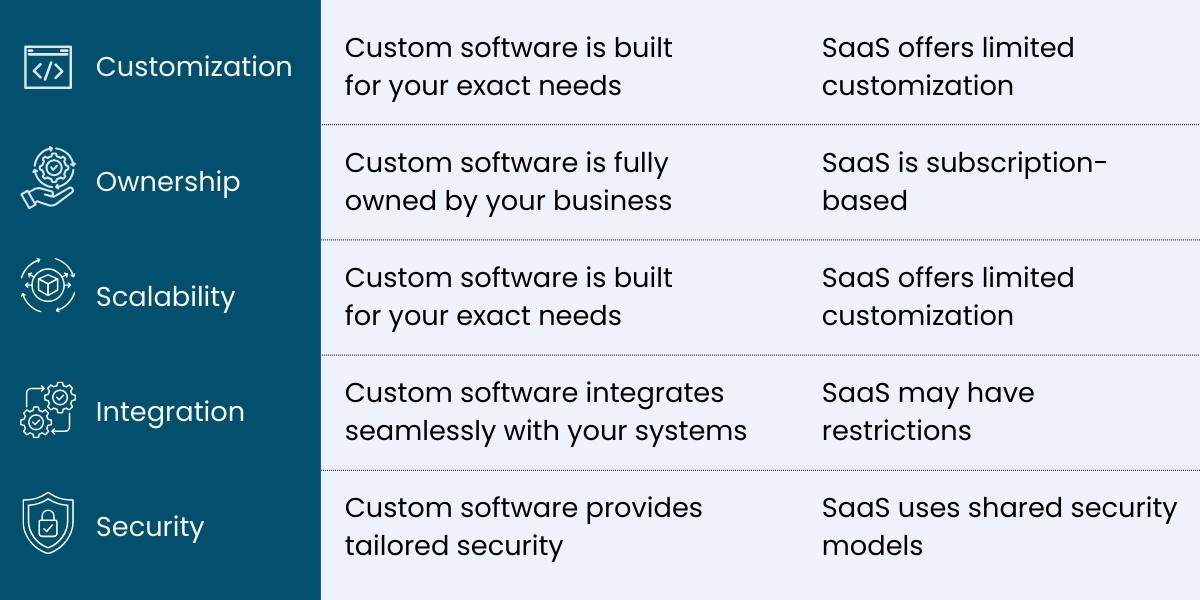
SaaS products are typically ready-to-use, cloud-based services. Providers deliver these products quickly and usually charge a monthly, or quarterly subscription fee; however, while SaaS products are suitable for fulfilling a broad range of business requirements, they generally do not provide for complex business processes, multiple levels of system integration, or a significant degree of data protection. SaaS products are great for small companies with limited technology budgets, but when businesses need advanced technology to process transactions, the only option is to develop custom software.
On the contrary, custom software is specifically tailored to one organization. The design and construction of a custom software system depend upon the organization’s particular business process requirements, along with the organization’s industry regulations and strategy. The organization’s ownership of the custom software includes its architecture, its functionality and, ultimately, its future direction.
1. Businesses Require Software That Fits Their Business Practices
Enterprises do not regularly function correctly with standard, established business workflow processes; Enterprises are complex and have multiple departments that rely on legacy systems for their workflow and both Federal and State regulatory compliance requirements unique to their business.
A SaaS Platform requires businesses to change their business workflow practices to accommodate the software, while custom software replicates a Business’s internal workflow and minimizes redundant steps, maximizing each area to be automated.
Enterprise alignment results in improved efficiency by decreasing the amount of training necessary, while removing productive bottlenecks.
2. Enhanced Data Security and Regulatory Compliance
In the USA, enterprise security and regulatory compliance issues are two of the most significant concerns for businesses; Enterprise Business Processes in industries such as Finance, Healthcare, Manufacturing, and Government, operate under stringent regulatory requirements governed by Federal Laws such as HIPAA, SOC 2, PCI-DSS and GDPR.
Custom Software provides organizations with the ability to establish a security framework from start to finish; Enterprises can determine levels of access to data, levels of encryption, establish audit trails and,, other regulatory compliance protocols. SaaS Platforms typically provide generalized Security Measures but provide a lower level of security that may not satisfy the requirements of a high-level or Industry-Specific Compliance Standards.
Custom Software provides Enterprises with control over where data is Stored, what Policies Control Access to the data and, how to control Security through Software Architecture.
3. Complete Ownership and Long-Term Cost Management
Initially, SaaS seems relatively inexpensive, but as the number of users grows, and as the need for premium features arises, the cost of an enterprise’s subscription will rise significantly. Over time, the associated licensing/retention storage/API Service fees will quickly exceed the costs associated with creating a custom-built Solution as more Users access that Solution.
On the other hand, Custom Built Software is a long-term investment. Enterprises can avoid the ongoing cost of recurring licenses and vendor lock-in. Enterprises will also gain complete ownership of their Custom Built Software System and will have total control of development and future enhancements, integrations, and Infrastructure on that Custom Built Software System.
For a U.S.-based enterprise planning to scale multi-year, gaining that Department’s level of control provides predictable long-term financial growth/forecasting and strategic flexible options.
4. Unified Integration with Enterprise Technology Stacks
Enterprises rely upon a complex system of tools, such as ERP platforms, CRM systems, HR management systems, Financial Applications, Data Warehousing, as well as Third Party Services and Applications.
Typically, SaaS tools have limited or costly integration and/or API access options; however, Custom Built Solutions can be specifically developed for integration across an organization’s entire technology Stack. Custom Built Solutions integrate your entire ecosystem, consolidating all data across systems, allowing for centralized access to that aggregated data and providing real-time Data Reporting and interactive Data analysis.
This capability will eliminate Data Silos and create visibility into the enterprise’s overall operations and support Automation across the enterprise.
5. Scalable for Business Growth
For the enterprise to grow, strategies and tools must grow with them. Massively expandable SaaS solutions tend to have limitations that can hinder success. In turn, the typical price for SaaS solutions is often more expensive than custom-built solutions.
Enterprise grade software was created for expanding business growth through large numbers of customers, high transaction volumes, using analytics, and spreading to new markets. The best way to accomplish this is through using a Cloud-enabled Architecture. Through advanced Cloud Native technology and the use of microservices for global collaboration among employees, your company will be able to execute tasks in a very scalable manner.
Having the ability to expand and scale is important for many enterprises within the U.S., especially those that operate in many geographical regions with various customer segments and pricing options.
6. Differentiate Your Business Model Through Innovative Solutions
When it comes to enterprise competition, companies do not compete by using standard solutions. Instead, business units compete with “Custom” Business Models/Workflow, Customer Experience, Data Strategy, Service Delivery Models.
Using Custom Software allows a company to develop their own specific business model without the boundaries of using standard solutions. Businesses that have the ability to automate processes, build a Custom AI system, and build predictive analytics dashboards will have a competitive advantage. Custom Software allows companies to differentiate themselves in the marketplace versus using SaaS solutions.
7. Improved user experience and performance
SaaS applications are typically geared toward wide audiences, which results in a lower level of performance and usability for an enterprise-level complexity. Customized software is developed for a limited number of users, most often internal teams and customers. The user interface is designed for maximum efficiency, and the software is optimized for maximum performance. The features of this type of software focus on real-world uses of the software, rather than a generic use.
The result is increased productivity, reduced error rates, and improved customer satisfaction.
8. Supporting Digital Transformation Efforts
Companies in the U.S. have invested significantly in cloud modernization, artificial intelligence (AI), automated processes, and data-driven decision-making. These initiatives require customized architectures and proprietary workflows. Custom software is the platform of digital transformation, connecting legacy systems to modern, cloud-based platforms, automating processes, supporting data analytics pipelines, enabling the creation of innovation-ready ecosystems, and facilitating the creation of unified digital infrastructures, in contrast to building disconnected SaaS tools.
When SaaS is Suitable; When SaaS Does Not Fit Your Company’s Needs
A company’s basic operational needs, initial growth phases, and well-defined/standardized processes are often met with SaaS solutions. Thus, SaaS becomes insufficient to meet the evolving needs of enterprises with:
- Very complex compliance requirements
- Extensively integrated systems and interfaces
- Advanced operational automation requirements
- High data security obligations
- Rapid, flexible growth patterns
- Differentiation of its products or services.
At this time, the only tool that can fulfil the needs of a growing enterprise to provide the flexibility, scalability, and innovation they require is custom software.
In Conclusion
Nationwide, US-based enterprises already are shifting away from SaaS and toward custom software development as it provides many critical elements required of large, successful enterprises that allow them to succeed in today’s high-tech business environment—flexibility, scalability, security, and innovation.
Custom software allows companies to develop their workflows, interface and integrate with their existing enterprise ecosystem, protect valuable company information and data, and continue to grow at the speed of their corporate growth. Custom software is more than just an alternative to SaaS for many large enterprises; it is the basis for the future success of those enterprises.
Ready to move beyond SaaS limitations? Empirical Edge delivers secure, scalable custom software tailored to your enterprise needs. Book a Free Consultation
Frequently Asked Questions
Enterprises choose custom software because it offers full control, stronger security, better integrations, and scalable architecture tailored to business needs.
Yes. Custom software is better for large enterprises because it supports complex workflows, high user volumes, system integrations, and long-term scalability.
Yes. While initial development costs are higher, enterprises save long term by eliminating license fees, reducing inefficiencies, and avoiding SaaS limitations.
Yes. U.S. enterprises prefer custom solutions for compliance, data ownership, and digital transformation.
Yes. Custom platforms are ideal for integrating AI, machine learning, workflow automation, and advanced analytics.
Written by: Empirical Edge Team