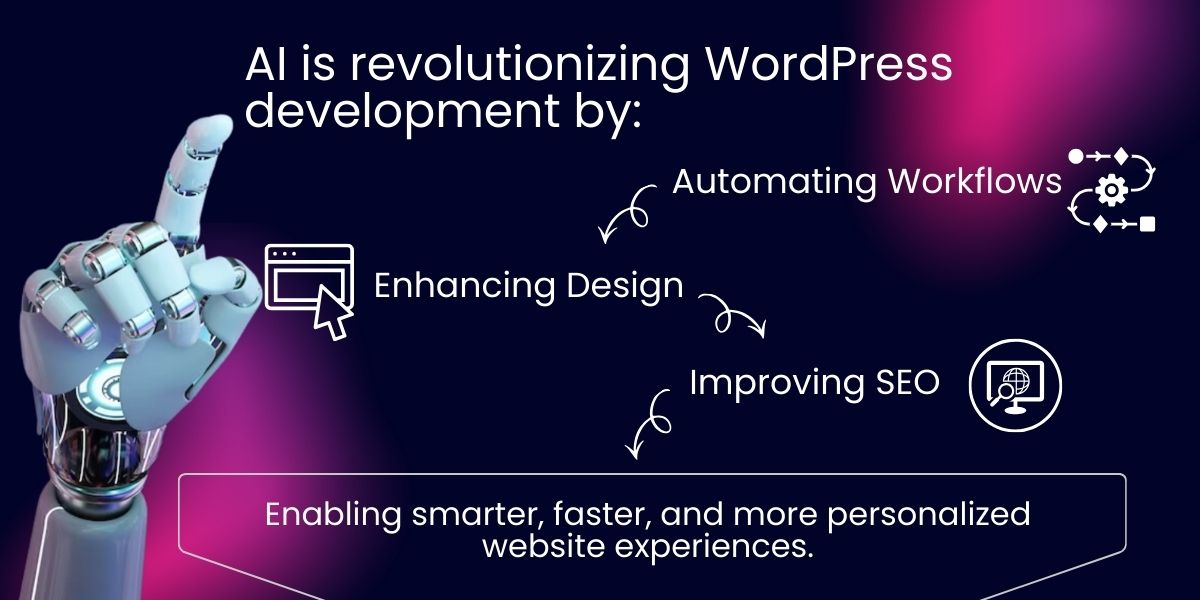
The use of artificial intelligence has gone from being a “vision of the future” to becoming a technology that helps developers build quality digital solutions faster and easier than ever before. WordPress is also seeing a shift in the way AI is Changing the build, manage, optimize, and experience of WordPress websites (Site Management) with the use of AI technologies, such as the use of predictive design, real-time personalization, security monitoring, and the ability to optimize your site using search engine optimization.
WordPress developers traditionally spent hours creating and repeating code. Developers would also spend an exorbitant amount of time optimizing their website’s images; structuring their website’s metadata; writing website content; and fixing common errors. However, the introduction of AI has allowed for the same repetitive tasks to be completed in a hyper-accurate way, freeing developers from performing maintenance tasks and allowing them to focus more on creating new features for their websites.
1. Developing Repetitive Tasks has been Fully Automated using AI
One of the newest and most impactful innovations of AI on site management within WordPress is the automation of tasks developers would previously be required to perform multiple times, often with little creativity or thought. The most common repetitive technical tasks that a WordPress developer would have performed included:
- Creating starter theme files,
- Generating the base code for plugins,
- Registering custom post types and taxonomies,
- Writing CSS markup for schema.org,
- Correcting troubleshooting problems for debugging, and
- Manually Optimizing Database Functions.
With modern AI-powered code helpers like GitHub Copilot, ChatGPT, and Cursor AI, developers can generate production-quality PHP, JavaScript, or plugin scripts using simple natural language prompts. Instead of writing 30–50 lines of code for a custom post type, developers can request “Generate a custom CPT for Events with taxonomy Location and featured image support” and AI generates it instantly.
Automation benefits include:
- 60–80% faster development cycles
- Fewer syntax errors
- Improved code consistency
- Zero time spent on repetitive research
- Faster prototyping, faster delivery
2. AI-Powered Plugins Are Changing the Way WordPress Sites Work

WordPress uses AI functionality primarily through plugins. In just the past 24 months, the marketplace for WordPress plugins has grown rapidly. Plugin developers now provide a variety of AI-enhanced plugin options that perform tasks like:
Content & Copy AI Plugins: Plugins that assist with writing articles and creating product descriptions, titles and hooks, calls-to-action (CTAs), rewrite and tone guards for existing content, and creating plagiarism-proof articles from existing content.
SEO AI Plugins: High-ranking plugins that provide recommendations for search engine optimization (SEO) and are designed to help optimize your website for higher search engine rankings.
Media Optimization AI Plugins: Plugins that allow you to compress your images automatically, create alt-text for your images as well as smart-crop your images, detect and remove unnecessary backgrounds and other objects, and summarize the content of videos you store in your media library.
Chatbot & Support AI Plugins: Plugins that provide automated responses to customer support questions. This category of AI-powered plugins allows you to create automated chatbot responses to customer questions and requests anytime and from anywhere on your website, along with providing automated order assistance for WooCommerce orders, and booking assistance for booking types.
AI-powered plugins reduce the manual work required of developers, store owners, and content teams while increasing their overall productivity due to the high-quality output of the finished products generated by these plugins.
3. AI Redefines WordPress UI/UX and Design Process
AI is reshaping many aspects of how WordPress-themed layouts and UI components work. Some examples of how AI is re-imagining the layout, UX (user experience), and design aspects of WordPress include:
Smart Layout Suggestions: Many AI-powered tools are able to analyze the content you provide to them, and make automatic suggestions about how to structure your layout including improving
Spacers: Determine whether a space in a layout has sufficient room for a specific piece of content.
Readability: Use an AI tool to evaluate whether your document meets necessary readability standards.
- Wireframe generation directly from a prompt, by generating WordPress wireframe designs using AI Design Tools.
For example: “Design a new WordPress Homepage with Hero Banner, Benefits Grid, Testimonials, Footer Ctas for my ERP SaaS site.”
Through the immediate visualization of Front-End Ideas through the use of Design Generators for Ai.
- Creating Gutenberg Blocks through Ai for Developers.
AI can create blocks of reusable Gutenberg code made of dynamic content for ACF or React developers in just seconds.
- Many Applications For Ai To Enhance User Experience On All Types Of Devices.
Today, the ability to use Ai to check UI’s for a variety of devices and formats has helped to prevent User Launch Manual Kit problems.
The result of these advancements is a significant increase in the quality of sites, easier to update and maintain a site’s design.
4. The Influence That Ai Is Having Upon All CMS Types and Formats For Creating Content.
With regard to “All” WordPress content, there is little doubt that Ai has had the largest impact on the evolution of content within the CMS (Content Management System).
Ai has revolutionized WordPress Content Creation within the CMS:
- Complete Seo Article Creation (1500+ words).
- Headline Generation, Hook/Social Media Post, Cta.
- WooCommerce Product Descriptions.
- Category Descriptions.
- Content Calendar(s).
- Updating & Revising Old Content for Improved Ranking Opportunities.
- Identifying the Intent of a Query (Transactional, Informational, Navigational).
- Creating Links Based on Topic Cluster(s).
- Recycled YouTube Content Into Blog Posts.
- Creating Content From Excerpts Automatically.
This gives huge business value because:
- Content teams no longer need multiple writers for multiple platforms
- Article output increases 10x
- Human writers focus only on accuracy reviews and creativity polish
- SEO gets better because content is structured for ranking, not word count
5. AI Is Boosting WordPress SEO Like Never Before
In the past, a significant amount of time and money were invested into SEO on WordPress projects but now AI is doing much of the work for you.
Here are some examples of how AI is helping with your SEO:
- AI has the ability to target the right keywords by using data to determine the best keywords for search engines.
- AI creates your page title, meta description, and og tags automatically for each page that you post.
- AI will automatically link your blog posts to each other based on the topic that the blog is about.
- AI creates schema markup, such as FAQ schema, product schema, and review schema in JSON-LD format automatically and accurately.
- AI will identify and inform you of keyword cannibalization and assist you with fixing content gaps.
- AI plugins will predict potential ranking difficulties for you and provide suggestions for optimizing your ranking before you publish your post.
Benefits of using AI to optimize your website for SEO include:
- Increased share of impressions
- Increased authority for the given topic
- Improved positions in the search engine results pages (SERPs)
- Increased opportunities for obtaining featured snippet listings
- Increased click-through rates (CTR) from search engine results pages.
In conclusion
Using AI will transform the traditional process of WordPress development into an automated build platform that provides a means for an entire system of WordPress developers to communicate with one another; reduce costs; improve speed and efficiency of publishing content to the web; eliminate many of the tedious repetitive tasks required when maintaining WordPress websites; increase website visibility (Search Engine Optimization (SEO)); enhance user interface and user experience (UI/UX); create experiences tailored to individual users; protect websites through enhanced security; and reduce reliance on people and resources that startup and enterprise organizations have historically been bound to.
This evolution is permanent, fast, and industry-shifting—and developers who adopt AI early will build websites smarter, faster, cheaper, safer, and with long-term scalability advantages.
Future-Proof Your WordPress with AI Innovation
Supercharge your WordPress site with AI-powered development, optimized performance, and intelligent automation — partner with Empirical Edge for custom solutions tailored to your business goals.
Frequently Asked Questions
AI is automating tasks like content generation, code assistance, design recommendations, SEO optimization, and predictive analytics — making WordPress sites smarter and faster.
Tools like AI content assistants, image optimizers, chatbot integrations, and automated testing plugins help boost speed, engagement, and reliability.
Yes — AI can personalize product recommendations, optimize checkout flows, analyze purchase trends, and automate customer support.
Some tools are plug-and-play, while custom solutions may require developers — but AI platforms are becoming increasingly user-friendly.
Written by: Empirical Edge Team