The Tool That Helped You Start Might Be Holding You Back
Every new business begins with the same principles: speed, efficiency, and resourcefulness.
You will start by using commonly used software to help manage customers, finance, processes, and markets. At first, everything works great – your team performs quickly, processes are simple, and you feel excited by the growth of your business.
Then something changes.
Your number of customers has increased, there is more complexity to the way you operate, your team is growing, you are introducing new services – all of a sudden, those tools that seemed to be perfect for you seem like they are limiting your operations. Data is now stored in different systems. Workarounds are commonplace. What should be simple now takes longer than expected.
At this point, many founders will experience friction, but aren’t exactly sure what the underlying issue is.
The issue is often not with the team.
It is also not with the strategy.
It is with your software.
This is why the dialogue around choosing between custom software or out-of-the-box software will be crucial.
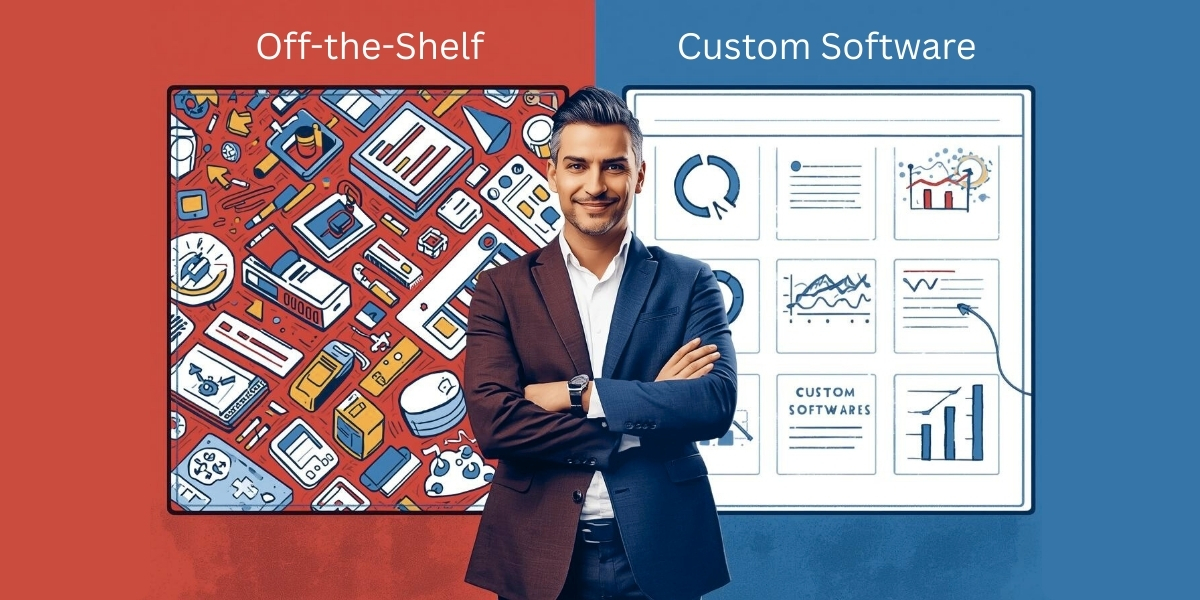
What Off-the-Shelf Software Is & What It’s Not
Off-the-Shelf (OTS) software refers to software that has already been developed and is available to many customers. OTS software was developed for many types of users, including common CRMs, accounting software tools, project management systems, support desk systems, and marketing software.
OTS software was designed to meet the most user needs and can typically be implemented for multiple types of businesses in several different industries and with little to no assistance from the vendor.
Why Do Companies Start Using Off-the-Shelf Tools?
There are several reasons for the abundance of OTS tools:
- Skewed investment costs
- Short delivery cycles
- Ease of transition into the OTS tool
- Vendor maintained software updates
- A lot of software functionality.
For start ups, using OTS software is the ideal option because it lowers their barriers to market entry and enables them to generate revenue quickly.
The fact that the tool works for many different companies and industries also means that the tools have not been designed for any one company’s requirements.
Where Off-the-Shelf tools Fail
As a company grows, and the complexity of the company increases, the generic nature of your OTS tools becomes inadequate.
Your Workflows Don’t Fit The Software
As a company develops new process and efficiencies in the company, the work that the company is performing and the way that the company performs those processes will not match with what the OTS software is expecting the company to be doing.
When this occurs, the following things occur:
- Manual workarounds
- Duplicate data entry
- Inconsistent reporting
- Process confusion
Cost Increases as a result of Scaling instead of Decreasing
It starts out being a low monthly fee and ends up having multiple subscriptions and premium tiers as well as having to pay for integrations between different products and finally having to pay for every user who accesses each product. The more you scale the business, the more your software costs grow instead of being optimized.
Slow Systems are a Result of Disconnected Systems
With every new tool you use, you will also have another place to log in and find your data through another dashboard. This means teams have to spend more time connecting each of these systems together than they will actually spend using them. Because of this, your leadership team can’t find a single source of truth.
You Don’t Always Control Your Own Software Systems
Instead of having a complete roadmap on which your business’ success relies, you will be relying on the vendor’s roadmap. If there is a change in product features, or you can’t access that product anymore, or if their prices become too high, you will have to adjust your business’s operations at the worst possible time.
Infinite Choice has made it difficult for many founders to see that they haven’t built a tech stack. They have built a collection of disconnected products or systems that cannot scale as your company scales.
What Custom Software Actually Means
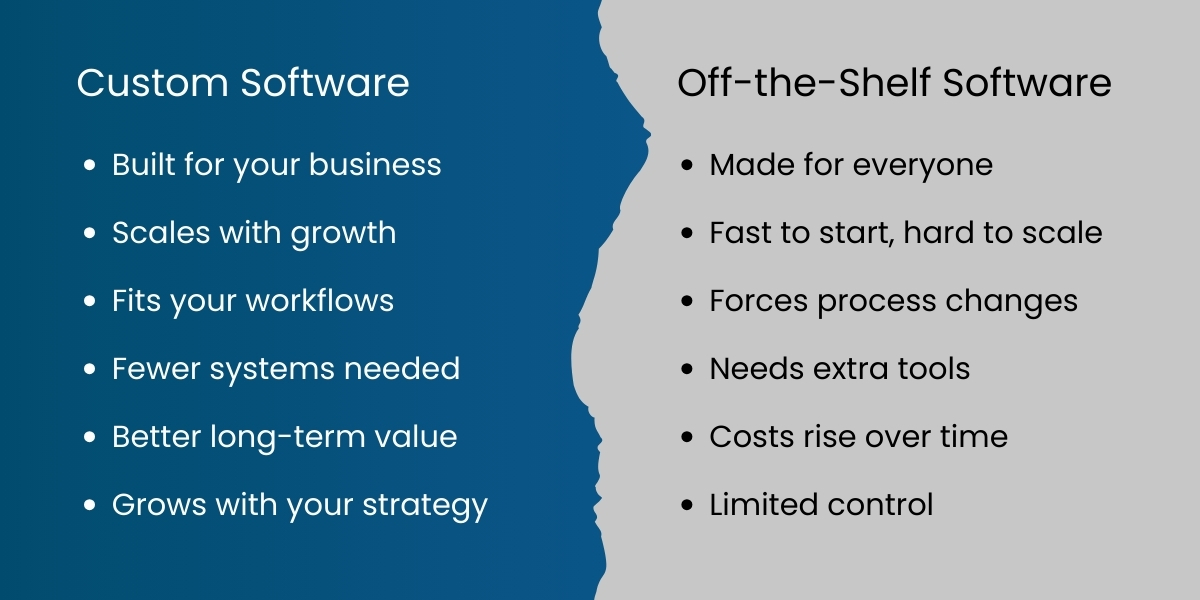
Custom software is designed specifically for your business’ needs, operations, and vision for the future.
With custom software, you will not need to change your operations to match the product; rather, the product will be designed to match your operations.
The custom software will allow you to create systems that are not just about having more options, but rather, they create systems that are less friction, clearer, support growth.
Core Benefits of Custom Software
- Built around your exact processes
- Scales as your business scales
- Integrates cleanly with existing systems
- Eliminates unnecessary features and costs
- Improves speed, accuracy, and control
- Creates competitive differentiation
Custom software turns technology from a limitation into an advantage.
Custom Software: Save Money Long Term
Most people think of Custom Software as costly because of the cost of development; however, Founders that only look at the first actual cost of developing Custom Software greatly miss the entire financial picture by only looking at upfront cost.
Save Recurring Software Fees
Instead of paying multiple software subscriptions, user licenses, and ADD-ONS for multiple software systems for life, a Custom Software Platform would replace all of these different software tools with one Custom Software Platform built specifically for you.
Eliminate Manual Labor Costs
Teams spending hours exporting files between multiple software systems, typing in the same data, correcting errors caused by others or trying to find workarounds between different software systems, would stop doing those things when all of their systems were integrated.
Less manual road time means:
- Fewer mistakes
- Speedier operations
- Less long term pressure on staffing.
Avoid System Replacements
Most Companies grow out of their off-the-shelf software platforms every few years and have to undertake expensive migration projects to a new software platform. A custom software platform evolves with your company instead of being replaced by your company.
Maintain Strategic Value
Custom Software Platforms are specifically designed to capture your unique workflows, data structures, and operational intelligence so no other company can subscribe to it.
In the long run, purchasing Custom Software Purchases is not the more expensive option, but rather the more financially prudent choice.
Custom Software Isn’t About Features — It’s About Freedom
Most founders don’t actually want custom software.
They want:
- Faster execution
- Clearer reporting
- Fewer errors
- Happier teams
- Better customer experiences
- Systems that don’t collapse under growth
Custom software delivers something generic tools rarely provide: freedom.
- Flexibility instead of forcing your business into predefined workflows.
- Control instead of vendor dependency.
- Freedom from endless tool stacking.
- Freedom to design operations around strategy — not limitations.
When software truly fits your business, it stops being something you manage and starts being something that works for you.
Why You’ve Chosen the Right Technology Partner

Selecting custom software is only half the battle. The partner you select will ultimately determine if the outcome is a strong partner that creates economic growth for your company/operator — or another technology system on which you expect results.
Empirical Edge – Creating Custom Software for Real Businesses
Empirical Edge helps Founders and Growing Businesses replace one-size-fits-all tools with custom systems built around achieving their long-term goals.
Located in Marlton, NJ, Empirical Edge provides professional IT services and custom software development to companies throughout the United States.
The primary focus of Empirical Edge includes the following areas:
- Custom Software Development
- Web and Application Development
- System Integration
- Cloud Computing Solutions
- Technology Consulting
Empirical Edge puts your business first and builds the right technology around it.
We take time to understand how your teams work, where inefficiencies exist, and what growth demands from your systems. Then we design and build software that aligns with real-world operations — not generic assumptions.
Our goal is simple:
help businesses replace software chaos with scalable clarity.
If your tools once helped you launch but now limit how you scale, it may be time to rethink one-size-fits-all software.
Custom software isn’t about building something complex.
It’s about building something aligned.
At Empirical Edge, we help founders turn software from a daily obstacle into a long-term advantage.
Connect with our team and discover how custom software can support your next stage of growth.
Frequently Asked Questions
Custom software is built just for your business. Off-the-shelf software is made for many businesses, so it may not fully match how you work.
It usually costs less at the beginning. But over time, monthly fees, extra features, and added tools can make it more expensive.
When your tools start slowing you down, don’t fit your process, or can’t support your growth.
Yes. It takes more time because it’s made specifically for your business. But the result fits better and lasts longer.
It reduces monthly tool payments, cuts down manual work, and grows with your business so you don’t need to keep changing systems.
Written by: Empirical Edge Team