


In choosing the right Content Management System for your business’s website, choices abound, and the favorites are Drupal and WordPress. One is not better than the other; in fact, it depends on some aspects where one is the best suited over the other. Each can be a game changer in the future of the website regarding its performance, scalability, and security. Therefore, which is best for your business? Well, now let’s begin with Drupal vs WordPress and which one of the CMS suits your requirement right.
What is WordPress?
WordPress is the world’s most used CMS, supporting over 40% of all websites. WordPress also boasts ease of use, flexibility, and a massive community of developers. It’s that one stop where one can have any simple blog, and up to full-scale e-commerce sites. With thousands of themes and plugins that exist for WordPress, a fast method of building and managing sites without any code exists.
What is Drupal?
Drupal is a more complex CMS, more suitable for bigger, more complex websites. It may be steeper to learn than WordPress, but it’s very powerful in terms of customization and flexibility. It’s also known for its robust architecture, scalability, and security features. This makes Drupal an excellent choice for businesses that require control over the structure of their site and want to manage complex content management tasks.
Key Differences Between Drupal and WordPress
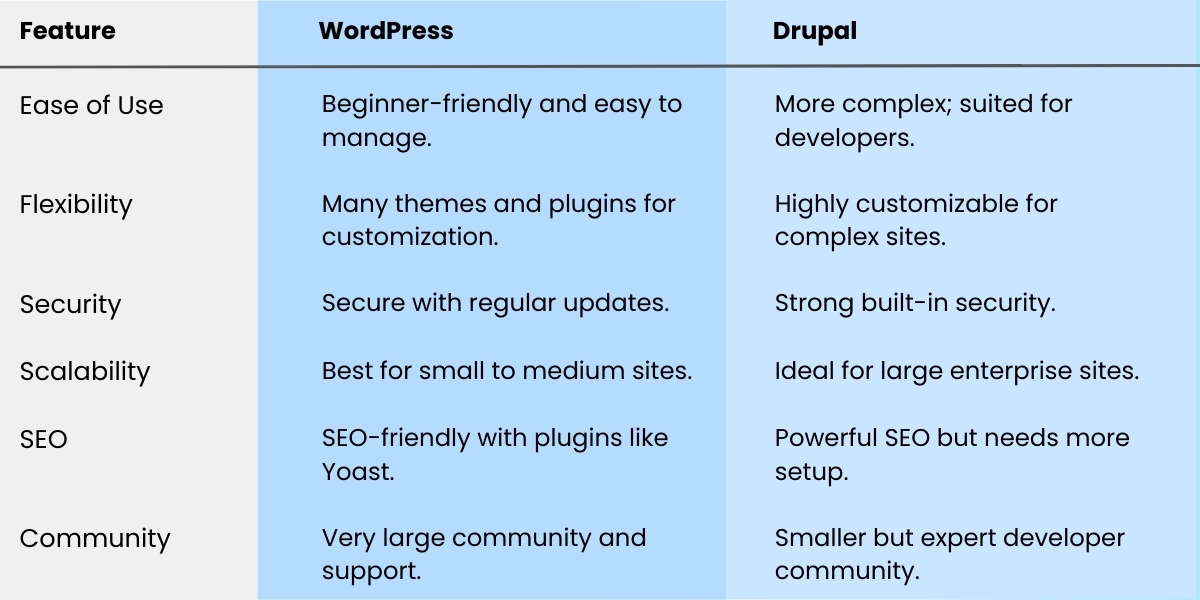
1. Ease of Use
WordPress: Extremely user-friendly-it is made for newbies. Non-technical persons can easily install and set up a website. Such an interface, even web development beginners can build up a completely working site.
Drupal: Much more powerful, but steeper learning curve. It really works for someone with technical knowledge, or who at least wants to spend time or money training, or hiring a developer.
2. Flexibility and Customization
WordPress: Really flexible; tens of thousands of themes and thousands of plugins are available. There is a real deepness in the ability to customize, which often requires custom code.
Drupal: More flexibility- Complex, more customization websites. It works in business houses who specifically needs functionalities and manage very voluminous content in organized patterns.
3. Security WordPress
Though WordPress is rated less unsafe, it gets most hacked by hackers worldwide. As most of this earth uses
WordPress for major numbers. Do keep your activated your plugins and all your updates and updates updated regularly.
Drupal: Drupal is arguably safer as is, in the box. This system is used generally for the governmental websites and big business due to fact that it focuses on security. Besides granular access control may be applied
4. Scalability
WordPress: WordPress suits small to medium size websites. It manages high traffic, but managing very huge, complicated websites or growth too rapidly is a little bit unwieldy.
Drupal: Drupal is very scalable. Built for enterprise levels with complicated content structures and therefore very apt for large enterprise sites or projects demanding advanced functionality.
5. SEO Capabilities
WordPress: WordPress is very SEO-friendly. With Yoast SEO plugins, it becomes easy to optimize content, meta descriptions, and keywords. It is a great choice for businesses that focus much on SEO.
Drupal: Drupal has good SEO capabilities but requires more manual configuration. Even though SEO on Drupal can be powerful, it is more technical and more setup than on WordPress.
6. Community and Support
WordPress: WordPress has a pretty large user base that includes developers and designers. Because of this, you will surely find tutorials, forums, and many solutions to your problems.
Drupal: Drupal’s community is small, but they are fiercely dedicated and very focused on advanced development. This enables detailed documentation and professional technical support for the more serious users.
Which CMS Should I Use?
Use WordPress if: You are running a small to medium-sized business and want to have a rapid, easy-to-handle site. WordPress is ideal if you need a simple, clean-looking site that doesn’t demand too much technical depth.
Choose Drupal if: You need a scalable, flexible platform to manage huge volumes of content or deal with complex features. Drupal is more appropriate for businesses that have specific needs or want to build a more customized, feature-rich experience.
Conclusion
Drupal and WordPress are two of the most powerful CMS platforms. What’s right for your business, however, will depend on your needs. Smaller businesses, which focus more on ease of use, speed, and flexibility, prefer WordPress. Drupal is the best fit for businesses with high demands such as scalability, security, and customization.
Before making a decision, consider the size of your business, the complexity of your website, and your team’s technical skills. By understanding the strengths and weaknesses of each CMS, you’ll be better equipped to choose the platform that will help your business succeed online.
Choose the Right CMS for Your Business
Selecting the right CMS can significantly impact your website’s performance, scalability, and user experience. At Empirical Edge, our experts help businesses choose and implement the best CMS—whether it’s Drupal or WordPress—based on their goals and technical needs.
Frequently Asked Questions
The main difference is usability and flexibility. WordPress is beginner-friendly and easy to manage, while Drupal is more complex but offers advanced customization and scalability for large or complex websites.
WordPress is generally easier to use due to its simple dashboard, large theme library, and plugin ecosystem. Drupal requires more technical knowledge but provides greater control for developers.
Drupal is known for its strong security framework and strict coding standards, which is why many government and enterprise websites prefer it.
WordPress offers a larger ecosystem with thousands of plugins and themes, making it easy to add new features without extensive development.
Both Drupal and WordPress support SEO. WordPress is more beginner-friendly with popular SEO plugins, while Drupal allows deeper customization for advanced users.
It depends on your needs. WordPress is great for blogs and small business websites, while Drupal is better suited for complex, high-traffic, or enterprise websites.
Written by: Empirical Edge Team