


The digital economy is becoming increasingly competitive, and the speed at which companies introduce new offerings is now a defining factor in winning market advantage. Organizations that can bring new products or services to market quickly gain a powerful edge—achieving faster customer adoption, stronger brand positioning, and quicker revenue generation. In today’s fast-moving environment, a successful go-to-market strategy is essential. As businesses look to innovate and scale, Custom Software Accelerates Go-To-Market Strategy by enabling faster development, smarter execution, and greater alignment between technology and business goals.
Generic off-the-shelf solutions may provide some support for day-to-day business operations, but they do not typically have the capabilities (agility, scalability, or strategic alignment) of Custom Software when developing a rapid, data-driven approach to go to market. Custom Software provides a business with a software platform that is intrinsically aligned with the business’s specific objectives, the business’s workflow processes, and the customer journey—thus, dramatically enhancing the speed in which a company designs, develops, launches, optimizes, and scales its products and services.
In this piece of writing, we will discuss the ways in which Custom Software can assist businesses, especially in the United States, in launching new products more efficiently, becoming more agile, and significantly exceeding their competitors’ capabilities.
Understanding Digital Age Go-to-market Strategy
A go-to-market strategy defines how a business sells its products or services to customers and includes:
- Target audiences and how to position yourself in the marketplace.
- Product development and readiness to enter the marketplace.
- Determine what sales and distribution channels you will use.
- How to execute a marketing strategy effectively.
- Provide customers with a positive experience and customer support.
- How to track and optimize your data.
In the past, most GTM processes were manual, siloed, and tedious. Success in today’s environment is derived from having the right tools and processes in place to support the automation of your business processes. Success can only be achieved with the use of technology and an agile mindset.
How Custom Software Helps to Accelerate The Go-To-market Process
1. Custom Systems Streamline Business Processes And Remove Bottlenecks
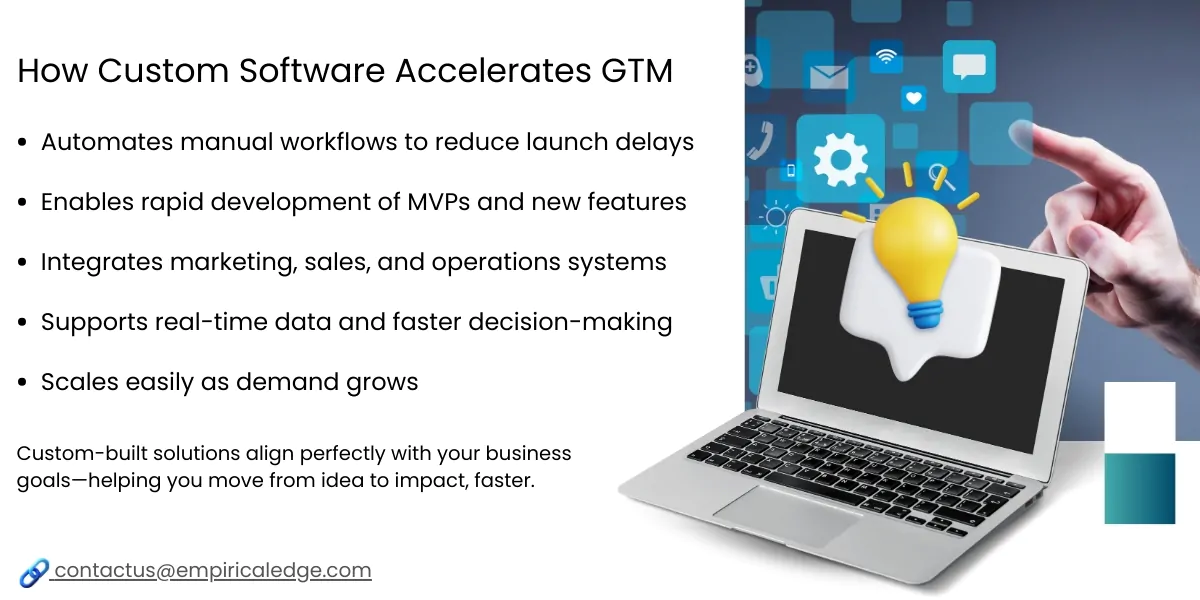
Custom software is built based on your organization’s internal processes, rather than the reverse. This helps to eliminate barriers between departments (i.e., Product, Marketing, Sales, Customer Service). Automated approvals, integrated dashboards, and integrated systems reduce the time it takes to develop and launch new products or services.
By automated repetitive tasks and overcoming system limitations, teams can develop, test, and engage with customers rather than being bogged down with workarounds.
2. Increased Speed in Product Development and Iteration
With customized software development, businesses can produce what is needed for their organization specifically. There are no bloated features and no rigid constraints. Businesses take advantage of systems such as agile frameworks, modular architectures, and scalable cloud to expedite the processes of building ripened products, rapidly prototyping, and continuously improving.
This allows businesses to:
- Validate their ideas sooner
- Launch pilot products sooner
- Respond quickly to market feedback
- Implement improvements with zero disruption
Faster product iteration translates to shorter GTM cycles and a higher degree of market relevance.
3. Enhanced Integration Between Various Technology Platforms
Disconnected systems account for the majority of delayed product launches and the result of disconnected systems is usually a lack of real-time insight for customers and product/service development teams in addition to many business functions, including CRM, ERP, BI, inventory, and marketing automation, among others.
Custom software solutions enable businesses to leverage custom solutions as a layer of intelligence that connects all disparate systems into a seamless environment. Connecting all necessary systems provides a more accurate representation of data. Additionally, connecting disparate systems enhances the ability of a business to collaborate in real-time and implement GTM strategies with the greatest amount of speed and confidence.
4. Analytics-Driven Decisions from Day One
Successful go-to-market strategies rely on insights, not assumptions. Custom platforms can be built with advanced analytics, dashboards, and AI-powered reporting baked in from the start.
This allows businesses to:
- Track campaign performance
- Monitor customer behavior
- Optimize pricing and promotions
- Predict demand trends
- Improve targeting and personalization
With real-time visibility into performance, leadership teams can pivot quickly—maximizing early traction and minimizing costly delays.
5. Customer Experience Personalization at Scale
Today’s go-to-market strategy is heavily reliant on a positive customer experience. Businesses are utilizing custom software to create unique digital experiences across multiple platforms, including e-commerce, websites and applications.
Through automation, intelligent onboarding, and unique product recommendation capabilities, these experiences maximize conversions and minimize churn, while increasing early adoption of new products in the marketplace.
As companies compete in marketplaces with significant competition (the typical US market), they utilize custom-built software platforms to provide personalized engagement as a means of distinguishing themselves from their competitors. When executed successfully, personalized customer engagement allows businesses to continue growing quickly versus losing out on potential opportunities.
6. Market Expansion Built-In Scalability
Many companies face the challenge of being able to launch new products rapidly while maintaining the ability to grow in the future. Custom-built software can be designed from day one with the ability to support new geographies, increase user volume, accommodate increased data volume and continue to function as business models evolve.
Using API-driven architectures and cloud-based development allows organizations to seamlessly grow and expand their product offerings—whether by entering new states or by implementing partner programs to support enterprise customers.
7. Increased Security and Compliance from Day One
Organizations developing new products must consider how they will relate to security and compliance. Developing custom software from the beginning will ensure that organizations have processes in place to protect sensitive information, establish role-based access and maintain compliance with all applicable regulations—thereby preventing expensive rework to comply with regulatory requirements.
Establishing regulatory compliance and security at the beginning of the product development process not only safeguards the organization but also fosters trust between the organization and its customers, partners and investors.
Why Custom Software Is Important To Businesses In USA
The US is a very competitive marketplace that thrives on innovation and values the customer experience. Today, businesses must bring products and services to market faster than ever, rapidly adapt to customer feedback, and deliver exceptional digital experiences. Custom software gives businesses that ability:
- Get to market sooner
- Become more efficient
- Create a better fit with their target customers
- Allow for multiple channels to reach customers
- Be able to expand and grow for the future with confidence
Today, custom software development is no longer just an option; it is a strategic necessity if they want to succeed [with] a SaaS business, logistics company, enterprise portal, or ecommerce ecosystem.
Conclusion
The go-to-market strategy is only as good as the software used to support it. Custom software converts your GTM strategy from just a plan to a living, breathing, scalable execution engine.
When you align your technology with your business objectives, you are able to get faster, clearer and more controlled speed-to-market, be able to launch more intelligently, adapt to changing market forces more quickly, and grow stronger than ever before in competitive markets.
Your Technology Partner for Faster Market Entry
From product development to system integration and optimization, Empirical Edge delivers end-to-end custom software solutions that help businesses reduce time-to-market and maximize launch success.
Frequently Asked Questions
A go-to-market strategy defines how a product is built, positioned, launched, and delivered to customers, supported by technology, operations, marketing, and sales processes.
Custom software removes system limitations, automates workflows, integrates tools, and enables faster development cycles—helping businesses launch products quicker.
Off-the-shelf tools often lack flexibility and scalability. Custom software is built around your business model, customers, and growth plans—supporting faster execution and long-term success.
Empirical Edge designs and builds tailored software solutions, integrates business systems, optimizes workflows, and delivers scalable platforms that enable faster product launches and continuous improvement.
Yes. From MVP development for startups to enterprise-grade platforms, custom software scales with business needs and market expansion.
Yes. Empirical Edge specializes in system integration to create unified ecosystems that streamline GTM execution.
Written by: Empirical Edge Team