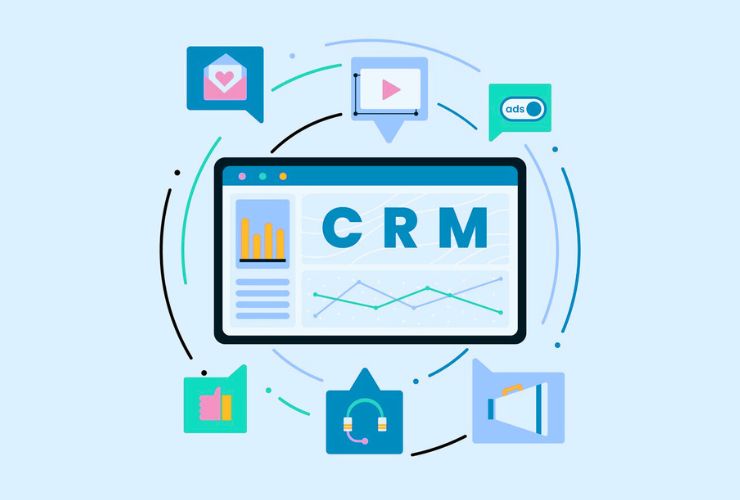


Modern business operations rely heavily on Customer Relationship Management (CRM) systems as the foundation upon which they operate. As businesses continue to prioritize customer experience personalized, increase customer loyalty and efficiency in their internal processes, the speed at which CRM Technology continues to evolve is increasing exponentially. The current state of artificial intelligence (AI) and automation will transform the landscape of CRM development, providing organizations with the tools to create intelligent, anticipated and extremely efficient systems.
This article discusses the ways in which AI and automation are changing how organizations develop CRMs, and why organizations should implement these new technologies into their CRM strategy.
Why AI and Automation Matter in Modern CRM Systems
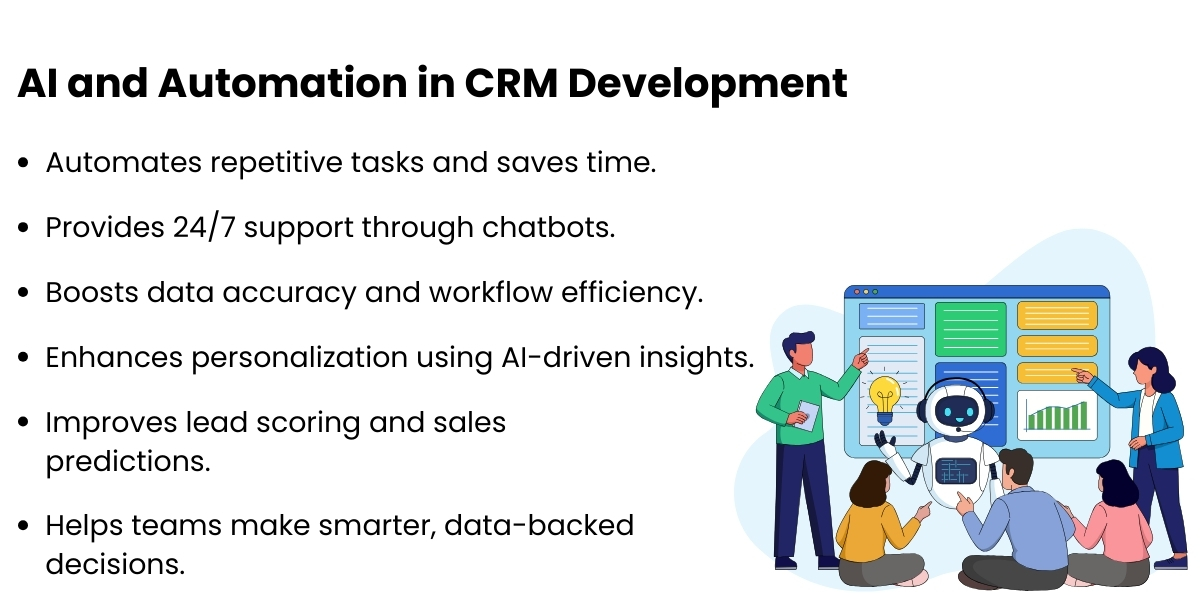
Traditionally, CRM systems had to rely heavily on manual, input of the company’s information, basic report generation, and reactive handling of the customer. The way businesses operate now, however, is significantly different; speed, accuracy, and the ability for a large volume of personalized service are paramount to being successful. This is where AI and Automation have become essential.
CRM Platforms that are built on AI can conduct analyses of customers’ behaviors to identify and forecast their purchasing behavior while simultaneously providing information on the ideal next action to take. The use of automation will remove repetitive tasks which will allow faster workflow completion and an ongoing verification process for customer information to ensure it is accurate and current. The combination of these two tools will transform customer relationship management into a strategic asset that can benefit companies throughout the entire business, from sales to marketing to customer service.
Key Roles of AI in CRM Development
1. Customer Personalization
AI can allow businesses to generate hyper-personalized experiences with customers, by assessing their buying habits, past purchases, likes/dislikes, and behavioral patterns towards engaging with a business.
Companies can use AI to:
- Provide product recommendations based on history
- Create targeted and responsible email campaigns
- Predictive suggestions to help sales reps in finding potential customers
Using AI for personalization allows a business to offer a more relevant customer experience.
2. Forecasting & Predictive Analytics
Using predictive analytics is one of the most valuable uses of AI in CRM. By utilizing data collected from the past, AI has the capability to do the following:
- Predict customer churn
- Forecast a business’ sales performance.
- Identify leads that have high potential.
- Suggest actionable strategies.
Using this information allows businesses to make data-driven decisions instead of relying on guesswork.
3. Chatbots and Virtual Assistants
AI-powered chatbots are able to respond to customer inquiries anytime, day or night, taking some of the workload off customer service teams. The capabilities of AI-enabled chatbots consist of:
- Answer frequently asked questions (FAQs).
- Assist with product recommendations.
- Schedule appointments.
- Provide support and route inquiries to live agents when required.
Getting customers’ questions answered quickly improves the overall customer experience and increases their chances of making a purchase.
4. Automated Lead Scoring
AI automatically evaluates the quality of leads and assigns a lead score based on engagement, behavioral characteristics, and demographic information. AI allows sales teams to:
- Focus their efforts on leads with the most potential.
- Improve follow-up strategies.
- Increase conversion rates.
Automating lead scoring with AI ensures that no valuable lead is missed.
5. Sentiment Analysis
AI analyzes customer messages, emails, reviews, and social media comments to understand their emotions. Businesses can detect:
- Customer satisfaction
- Potential issues
- Market perception
Sentiment analysis helps companies improve customer relationships before problems escalate.
The Role of Automation in CRM Development
Automation will significantly improve efficiency of sales teams and support teams by providing consistent, effective and reliable processes in business operations.
1. Elimination of Manual Entry into the System: Automation will automate the process of collecting, entering and organizing customer information through forms, email, web activity, and social media, to ensure the correct entry of customer information, and save both time and effort for the support team and sales team.
2. Automation of Workflows and Processes: Workflow automation allows users to automate their daily repetitive tasks, including follow-up emails, scheduling meetings, assigning leads, and updating records, enabling consistent and efficient work processes across departments.
3. Marketing Campaign Management Automation: Marketing CRM systems utilize automation to effectively deliver their messages to customers. Businesses can create drip email campaigns, personalized offers, event-triggered communications, and multi-step actions to ensure the appropriate communications are delivered to the intended customers at the proper time.
4. Automated Customer Support: Automation provides customer service reps with skills to effectively manage tickets received from customers, provide quick responses, and route inquiries to the appropriate support reps, with the use of automated ticket assignment, prioritizing, self-service portals, and collecting consumer feedback automatically, improving the quality of service delivered to customers and decreasing the response time to customer inquiries.
5. Real-time Reporting & Dashboard Reporting: Reporting dashboards and real-time dashboards will consolidate customer data and provide insights into sales performance, customer engagement, support metrics, and marketing. This will provide users with easy, immediate access to maintain and observe performance metrics.
Benefits of AI and Automation in CRM Development
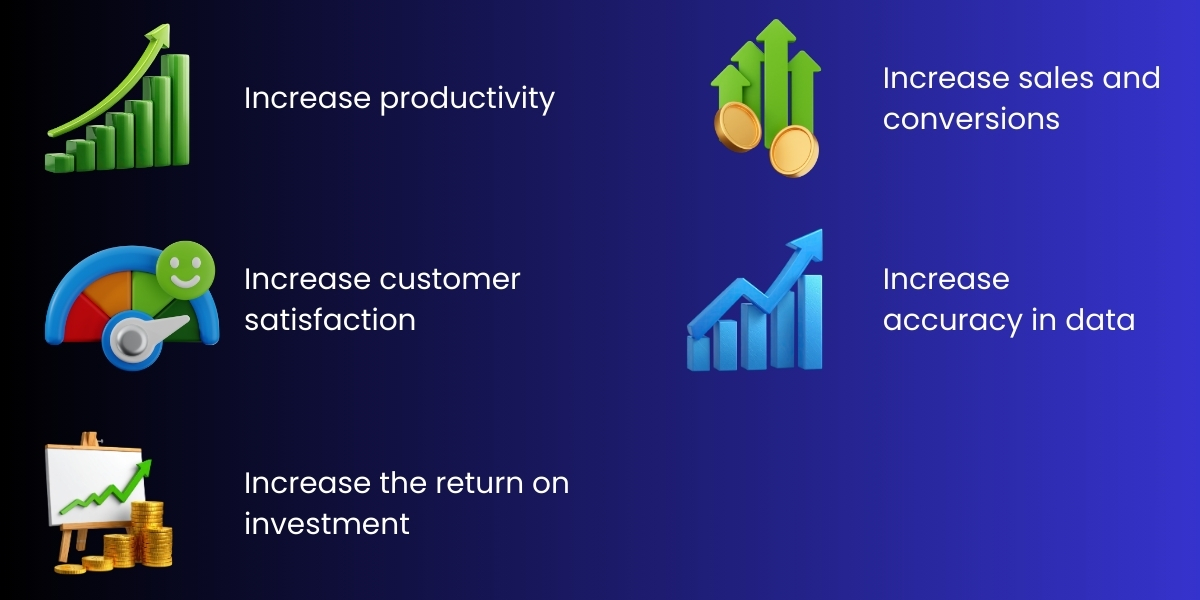
When a company adds AI and automation to their CRM systems, the company will have several benefits:
1. Increase productivity
Instead of spending time on manual processes, the teams can spend their time on high-value projects. AI assists in providing decision support for employees while automation provides solutions for routine work.
2. Increase sales and conversions
An AI tool can assist with lead scoring, providing the correct leads to pursue, and has the capability of turning those leads into sales quickly.
3. Increase customer satisfaction.
Using AI tools such as chatbots provides customers with quick and accurate responses and helps build a customers’ loyalty to a company.
4. Increase accuracy in data.
By automating the collection and processing of data, it is easier to eliminate human error and keep your data clean, updated, and accurate.
5. Increase the return on investment.
The company will save time and lower operating costs to retain more customers and ultimately increase their profit margin.
Conclusion
Artificial Intelligence and Automation are changing the way traditional CRM Development Systems will be delivered to the client, and are incorporating these technologies into a Customer Relationship Management Platform that is a hybrid of intelligence, analytics and data-driven technology.
Employing Artificial Intelligence (AI) CRM solutions allows companies to gain a competitive edge in terms of customer experience, while also allowing for improved decision-making and streamlined processes.
As consumer expectations continue to rise, it is expected that Artificial Intelligence-enabled CRM technology will become a necessity for all modern Businesses, and businesses who invest in new technologies now will most likely develop more substantial customer relationships and sustain continuing growth within their organizations through the use of these technologies.
Frequently Asked Questions
Yes. AI-driven CRM solutions can be scaled to fit small and mid-sized businesses, helping them automate repetitive tasks, improve customer insights, and compete with larger enterprises.
Yes. Professional CRM development follows strict security standards including data encryption, access control, compliance (HIPAA, GDPR, SOC 2), and secure cloud infrastructure.
Development time depends on features, integrations, and data complexity. Basic AI automation can take a few weeks, while advanced predictive CRM platforms may take several months.
Empirical Edge designs and builds custom AI-powered CRM solutions with intelligent automation, predictive analytics, secure architecture, seamless integrations, and ongoing optimization.
Written by: Empirical Edge Team