



Precise sales forecasting is critical for organizational planning, resource allocation, budgeting, and revenue generation. SugarCRM offers flexible and powerful forecasting capabilities, but forecasting will only be as accurate as your data is clean, your pipelines are well defined, and your forecasting methodologies are utilized correctly.
This article will walk through tried and trusted advice to help you create a better forecasting process using SugarCRM, allowing your team to make better data-informed decisions.
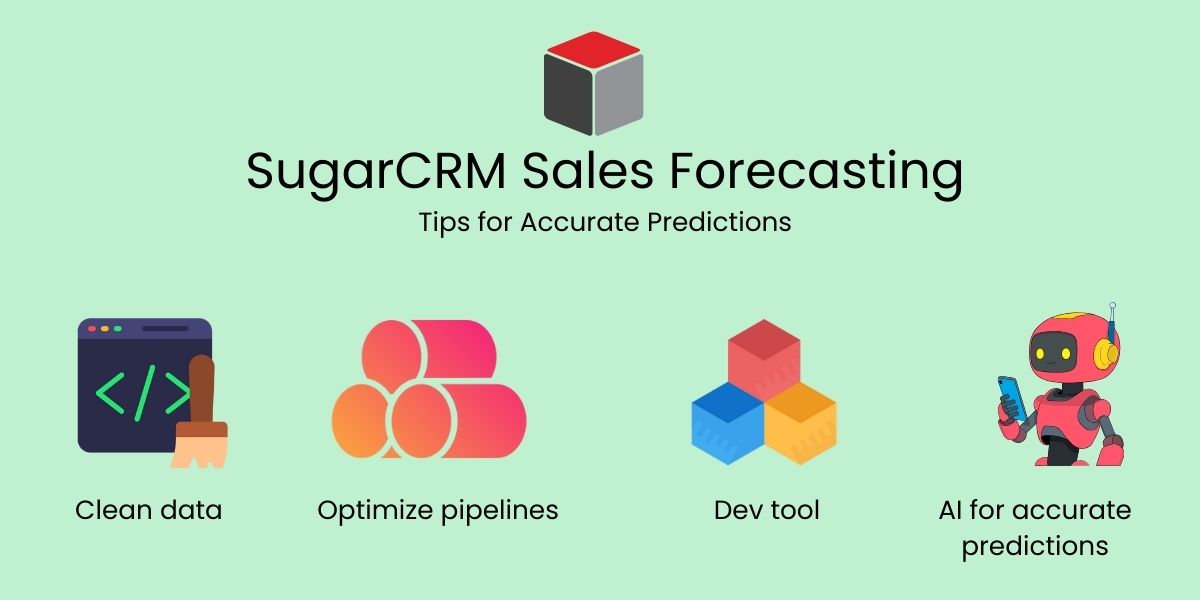
1. Starting With Clean, Well-Organized CRM Data
Sales forecasting will only be as good as the data that is in your SugarCRM. Outdated/incorrect records will skew your forecasts.
Ways to Increase Data Accuracy
- Update records on leads and deals regularly.
- Remove duplicates and old stale opportunities.
- Use consistent naming conventions and definitions for pipeline stages.
- Make sure your team understands the use of high-quality data.
With clean data, you have the starting point for reliable forecasting.
2. Define a Clear Sales Process and Pipeline Stages
Having clearly defined pipeline stages is critical for consistent forecasting. If every sales person is using different stages, your ability to forecast is muddied.
How to Fix It
- Clearly define each stage of the sales process across the organization
- Assign team members with a defined % likelihood that the deal will close
- Clearly identify what a deal needs to look like before it can advance.
- Quarterly review and revise pipeline stages so that they are aligned with your organizations overall goals and objectives.
When sales processes are consistent, the accuracy of your forecasts will improve.
3. Utilize the Forecast Module within SugarCRM
SugarCRM offers several independent functions that allow you to manage quotas, analyze performance, and forecast future sales.
Essential Functions:
- Written Committed Forecasts: Confidently anticipated deals to close
- Written Best Case Forecasts: Deals that are in play that can be closed with some diligent effort
- Written Pipeline Forecasts: Deals with visibility to closure from every stage within the revenue funnel
- Quota Management: Tracking one’s performance against quotas
- Historical Trends: Reviewing previous sales patterns broken out by months and quarters
Properly using these modules allows you one to keep 360° sales visibility on future sales.
4. Track Sales Activity in order to understand the real opportunities
Tracking activity allows you to understand the context of the opportunity development. Activity tracking could indicate a higher probability of closure.
Best Practices:
- Log every call, email, demo and meeting
- Log the follow-ups and next steps in the deal record
- Use Activity Streams and Dashboards to track opportunity progression
- Ask representatives to regularly update notes for any given opportunity
If you can see it, you have a better opportunity to forecast it.
5. Utilize the historical data to predict future sales
SugarCRM’s reporting capabilities provide avenues to review previous performance, trends and seasonality in order to predict future averages, forecasts and budgets.
Ways to utilize historical data:
- Compare same quarter-over-same quarter growth
- Look for trends regarding conversion rates (e.g., how many attempts it takes to close the deal)
- Frequency of peak sales periods and slow periods
- Analyze the performance of each rep and their average deal cycle (funnel time)
Detrimental or insightful historical analysis and reporting of activity and sales will dictate for better forecasting.
6. Utilize AI and Predictive Analytics
The modern releases of SugarCRM provide AI-enabled insights via SugarPredict. These insights improve your forecasts by reviewing patterns that are undetectable to the human eye.
AI Benefits for Forecasting
- Predictive scoring of your leads.
- Intelligent prioritization of deals.
- Sales forecasts based on probabilities.
- Identifying risk before it manifests.
- Better estimating the duration of sales cycles.
AI provides a powerful element of precision to your CRM forecasting.
7. Review and Refresh Your Forecasts on a Regular Basis
Forecasts should always be reviewed on an ongoing basis—not just at month-end.
Consistent Update Suggestions!
- Routine reviews of your pipeline on a weekly basis.
- Refresh deal stages after every substantial engagement.
- Refresh expected close dates when warranted.
- Examine deals that remain stagnant in a stage for too long.
Regular updates will keep your forecasts appropriate and actionable.
8. Build Custom Dashboards to View Forecasts
SugarCRM provides the dashboards and reporting capabilities for teams to access a visual representation of performance gaps and their results quickly.
Useful Dashboards
- Forecast versus quota.
- Monthly revenue in pipeline.
- Reports of aging opportunities.
- Win/loss analysis.
- Tracking your team’s activities and behaviors.
Visual dashboards will allow leaders and reps to make decisions fast as they continue to inform.
9. Motivate Sales Representatives to Predict with Integrity
Sales professionals tend to either inflate or diminish their deals. Having them predict realistically is really important.
How to Measure Improvement
- Develop clear expectations around scoring opportunity.
- Promote risk assessment transparency.
- Train reps on how to assess deal health.
- Incentivize only forecasting accuracy, not just sold deals.
When culture around forecasting improves, the forecasting accuracy improves.
Conclusion
SugarCRM has a highly capable forecasting tool, but accuracy is determined by your team deploying it correctly. Data integrity, pipeline stage consistency, trend history, AI features, and regular updates of opportunities are necessary steps in increasing the predictive capacity of forecasting your organization.
Accurate forecasting allows your organization to determine stronger strategies, allocate resources accordingly, and experience predictable revenue growth.
Optimize Your Sales Forecasting with SugarCRM Expertise
Ready to improve your sales accuracy and make smarter growth decisions? Let Empirical Edge help you implement and optimize SugarCRM forecasting — from data strategy and pipeline insights to predictive analytics and real-time dashboards.
Frequently Asked Questions
Sales forecasting uses CRM data like pipeline activity and historical trends to predict future sales volumes, helping teams plan resources, revenue, and targets more accurately.
SugarCRM’s forecasting tools combine historical and real-time data to give insights on pipeline progress, win rates, and trends, reducing guesswork and improving forecast accuracy.
Accurate forecasting relies on clean, consistent, and up-to-date data — the more complete the data, the more reliable the predictions will be.
Written by: Empirical Edge Team