




As more businesses go digital, more businesses have to depend on numerous technological platforms to support the multitude of ways they do business (e.g., customer relationship management (CRM), enterprise/erp, HR, Accounting, Projects, and many other app types). Each platform provides a different feature set and function for the business, but they are often used in separate work environments (aka silos).
This leads to wasted time having to switch between systems, transferring data manually from one to the other, and/or correcting issues caused by broken workflows.
System integration solves the problem of having many different systems having to communicate with each other seamlessly, which in turn creates automated workflows, reduces the amount of manual work, and increases productivity in all facets of your operations.
This blog will describe the theory behind system integration for the automation of business workflows and why it is a key component of the digital transformation movement.”
What is System Integration?
System integration is when you connect multiple systems/applications together so they can work together as one single application (platform).
It enables data to move easily between systems without the need for any manual data entry. This means businesses will have faster, easier, and more accurate processes.
An example of this would be:
- A customer places an order – the CRM app will automatically update
- Your inventory app will update with the new stock levels
- Your accounting app will create an invoice
- Your shipping app will create a shipping request
As you can see, all these steps occur without any manual intervention, because all the systems are integrated correctly.”
Why Workflow Automation Matters
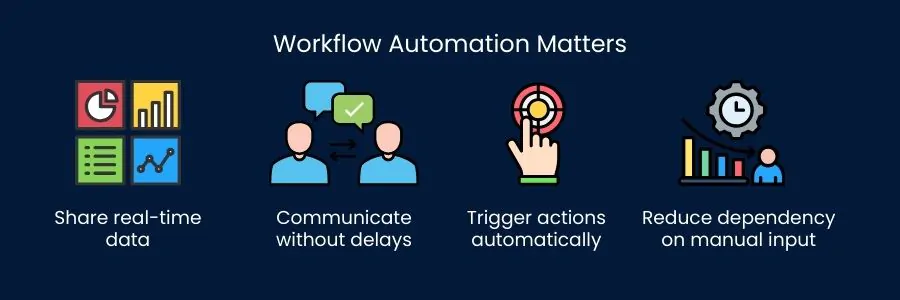
Workflow automation helps businesses reduce time-consuming tasks, improve accuracy, and enable teams to focus on strategic work instead of repetitive activities. However, automation cannot work effectively if systems are not integrated.
For automation to succeed, your applications must:
- Share real-time data
- Communicate without delays
- Trigger actions automatically
- Reduce dependency on manual input
System integration lays the foundation that makes all of this possible.
The advantages of integrating systems to create better business work flows:
1. Enhances Real-Time Data Flow Across Systems
By integrating systems with one another, you increase the amount of real-time data available to all departments, allowing for more informed decision-making and better collaboration among departments.
Sales will be able to access the most recent information regarding customers, finance will be able to pull accurate billing information for customers, and operations will have the ability to see real-time inventory levels. With integrated systems transferring the data, companies can now make more informed decisions and increase the accuracy of their operations and overall collaboration between departments.
2. Eliminates Manual Work and Reduces Errors
Integrated systems will allow you to eliminate the need for manual data entry. Eliminating manual entry not only speeds up the overall work flow process, but also reduces human error in the workflow.
All data will only have to be entered into the integrated system once; after that, it will be reused throughout the entire organization. Once a data entry is made into the integrated system, it will automatically trigger other workflows according to the established rules. Additionally, every update will be done across the entire organization and be available without having to manually input it throughout each department.
3. Improves Customer Experience Through Faster Processes
Customer service and support departments have very specific expectations of both a fast response time and accurate data. By utilizing system integration, businesses can streamline their workflow for customers, thus exceeding customer service expectations and creating a positive experience for customers.
For example:
- Support teams can instantly access order history
- Sales teams receive automated lead notifications
- Customers get real-time updates on orders or service requests
Integrated and automated workflows translate to faster response times, better service, and higher customer satisfaction.
4. Supports Collaboration Between Diverse Teams
Isolated Systems: When departments operate independently from each other, they’re often left with limited access to current or complete information. This results in a breakdown of communication and a duplication of effort, as well as inconsistencies within the data, due to each department relying on its own ‘version’ of the truth.
Through system integration, each department will now have access to shared data, be able to automate cross-departmental workflows, and be able to collaborate more effectively with each other, without the worry of siloed information. By creating a single source of truth for all departments, system integration promotes improved team dynamics, greater visibility and operational consistency across the organization.
5. Enables Intelligent Automation through AI / ML
Today’s robotics / automation are not simply about executing a set of rules, they’re more cognizant / intelligent than that. Effective use of AI / Machine Learning (ML) tools requires an abundance of consistent, clean data that is collected and stored properly.
With an integrated ecosystem, businesses have access to:
- Centralized repository of data
- Unified view of information
- Standard formatting of all data
With these key elements in place, businesses will be able to seamlessly leverage AI/ML technology to enable automated forecasting, anomaly detection, and other smart decisions.
6. Build Scalable Business Processes
As a business scales, it becomes increasingly difficult to manage multiple disparate systems within the organization. By implementing an integrated ecosystem, a business can grow its existing workflow without increasing the number of employees it needs to execute them.
The use of an integrated ecosystem gives organizations the ability to easily and inexpensively:
- Incorporate new tools
- Integrate new automated workflows
- Grow without increasing the number of employees
- Ensure that each department has access to consistent data.
When an organization has a fully integrated system in place, its scalability is inherently seamless and economical.
7. Improve the Security and Governance of Your Data
There is a greater chance for an organization to experience a breach of security or a failure to comply with legal requirements when it operates with multiple systems. The centralization of all data access and security controls achieved through the implementation of an integrated ecosystem minimizes this risk significantly.
This ensures secure, governance-driven workflows that meet industry compliance standards.
Business owners must consider implementing system integration to streamline their processes, automate workflows and remain competitive within a digital future.
When Should Businesses Implement System Integration?
Integration improves efficiency and automation of workflows significantly, especially for businesses that face the following challenges:
- Teams frequently switch between multiple applications
- Employees must manually transfer information from one application to another
- Customers receive delayed responses
- Companies find difficulty expanding their business operations
- Successful workflow automation
- Applications do not have consistent datasets or often have duplicate records.
If your organization encounters any of the aforementioned challenges, system integration can improve the efficiency of your organization.
Conclusion
The business of today cannot afford to not have system integration because it will provide the business with the ability to streamline processes, automate workflows and remain competitive in the digital market. By connecting all of your organization’s systems into one cohesive ecosystem, businesses can eliminate manual work, increase the accuracy of work outputs, speed up the time it takes to complete a task and provide improved collaboration between team members.
Whether you are seeking to improve the overall customer experience, increase productivity levels or facilitate long-term growth, by integrating your business system you will create a sound foundation for developing effective workflow automation and creating sustainable business growth.
Frequently Asked Questions
System integration enables automatic data sharing between tools like CRM, ERP, accounting, HR, and marketing platforms. This removes repetitive tasks, eliminates data duplication, and creates faster, error-free workflows.
It solves common issues such as disconnected systems, manual data entry, slow approvals, reporting delays, communication gaps, and operational inefficiencies.
By automating data transfer and task execution, employees spend less time on manual work and more time on strategic activities, which significantly improves productivity and efficiency.
When implemented correctly, system integration improves security by centralizing access control, standardizing authentication, enabling real-time monitoring, and reducing data handling risks.
Empirical Edge delivers secure, scalable system integration solutions that automate workflows, connect business platforms, reduce operational costs, and improve overall performance.
Written by: Empirical Edge Team