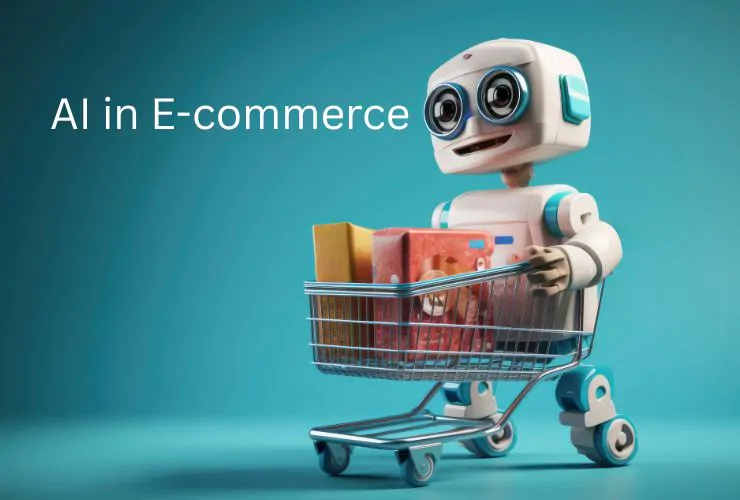



Over the past five years, eCommerce has developed much faster than it did in the last two decades. The increased expectations of today’s consumers and the growing competition in the online market have led to retailers using Artificial Intelligence (AI) and personalization techniques to create more meaningful shopping experiences based on consumer data. Customers expect much more than an online place to shop today; they want relevant product recommendations, quick delivery times, accurate search results, and available customer support. AI allows retailers to use the information they gather from customers to offer intelligent solutions that increase customer engagement and drive revenue.
In this blog post, we’ll talk about how AI and personalization will change eCommerce, and why it’s essential for retailers to incorporate both technologies into their business to remain competitive.
1. AI product recommendations
AI’s ability to offer personalized product recommendations is one of the biggest changes to eCommerce. Today, people expect brands to know exactly what they want. To help brands guide shoppers to the right products, AI will analyze what people are doing in the following ways to create personalized recommendations based on their behavior.
Where will customers be presented with recommendations?
- Product detail pages
- Homepages
- Checkout
- Push notifications
- App
How are personalized recommendations helping drive more and better business? By increasing
- average order value,
- conversion rates,
- customer satisfaction,
- repeat purchases.
Top retailers such as Amazon, Netflix, and Spotify all attribute their success to intelligent recommendation engines; however, businesses of all sizes now have access to this strategy via AI tools.
2. Personalized Shopping Experiences using AI
AI enables eCommerce companies to provide one-to-one personalization at scale, allowing retailers to create an experience that is customized to each customer as opposed to presenting every customer with the same promotions, offers, and layouts based on their interactions with the website or mobile app.
Examples of AI personalized shopping experiences include:
- Dynamic website content based on visitor segments,
- Custom homepage promotional banners,
- Products sorted based on context, and
- Custom discounts, browsing reminders, and restocking notifications.
By combining personalization with emotional engagement, customers feel seen and understood and, as a result, become more loyal customers.
According to a recent survey, 80% of customers prefer to buy products from brands that offer personalized recommendations.
3. Site Search Gets Smarter
When customers misspell a word or use a phrase they did not expect in a traditional keyword search, it can fail. AI-powered search engines use Natural Language Processing (NLP) technology:
- To understand a user’s intent
- To interpret various forms of a term or synonym.
- To deliver relevant search results quickly.
- To automatically provide suggestions for terms you might be looking for.
- To improve accuracy over time via Machine Learning
AI search engines also learn from customers’ click patterns and conversions so that they continuously improve their results every day.
Because of this, they help reduce the chances of users bouncing off from their site, guiding them directly to the products they are searching for, which results in significantly improved conversion performance.
4. AI Chatbots: A Better Way to Provide 24/7 Customer Support
Today’s consumers are looking for immediate assistance, 24 hours a day, 7 days a week. AI chatbots or virtual assistants are your solution to providing that assistance.
- AI chatbots answer frequently asked questions, such as:
- Help customers decide which product(s) to purchase.
- Track an order.
- Process a return, or exchange a product.
- Recommend a product.
- Provide support in multiple languages.
With AI-powered chatbot support, customer service departments experience a reduction in workload, and response times are improved dramatically.
The result? Quicker, less expensive solutions, and happier customers.
AI chatbots can also transfer complex inquiries and conversations seamlessly to live agents, thereby creating an efficient and user-friendly hybrid support system.
5. Predictive Analytics
With machine learning predicting consumer behaviour, AI uses the following factors to help eCommerce brands predict sales and demand:
- Seasonality
- Inventory Turnover (how quickly stockler go out of stock)
- Customer Lifetime Value (how much money a customer will spend over the lifetime of their purchase(s))
- Effectiveness of marketing campaigns (i.e. what percentage/success rate is generated by each campaign).
- Popularity of products
- Buying patterns.
Using this data, eCommerce brands can also use Predictive Analytics to make better business decisions such as:
- Improved inventory optimization
- Promotion planning
- Product placement
- Reducing Stockouts or Overstocks
- Identifying High-Value Segments
Predictive Analytics allows brands to be more proactive when developing their sales strategies, rather than just guessing at what may work.
6. Automation of AI
In addition to enhancing the customer experience, AI enhances back-end processes within eCommerce. Brands can use AI to automate:
- Management of inventory
- Processing customer orders
- Sending emails
- Optimizing the pricing of products
- Identifying potential fraud
- Processing product returns.
By automating these processes, brands significantly decrease the amount of time needed to fulfil orders and reduce their labour costs, while increasing the efficiency of their operations. For many growing online brands, automation is a vital step toward expanding their business without overwhelming their employee base.
7. Marketing Campaigns Based on Hyper-Personalization
Data-driven, behavior-based marketing allows businesses to personalize marketing efforts with the help of AI. Rather than send a generic email to all customers, businesses can:
- Group customers into segments based on their interests.
- Develop customized email sequences based on triggers.
- Create reminders for the user based on their activities.
- Deliver targeted push notifications to specific groups.
- Optimize the target audience for ads.
Higher engagement, click-through rates and conversions are achieved from personalized marketing campaigns. Furthermore, by personalizing the customer experience, businesses create more substantial relationships with customers throughout their entire life cycle.
8. Personalized Retention Strategies Create Increased Customer Loyalty
With AI, brands can determine when a customer is likely to leave, thereby triggering automatic re-engagement strategies. Personalized loyalty programs may include:
- Birthday discounts
- Tailored rewards
- Specialty discounts
- Customized product bundles
Upselling and cross-selling opportunities based on insights generated from their interactions with their brand.
Brands that utilize AI for retention strategy development will often see significant growth in repeat business and long-term value.
9. Automatic Detection of Fraud and Secure Transactions
Security is an integral issue for e-commerce businesses. With AI, businesses can keep their customers safe through:
- Real-time Fraud Detection.
- Pattern Recognition.
- Alerts for Suspicious Activity.
- Validation of Secure Payments.
- Identifying Bots.
By evaluating , through AI, the transaction patterns of each customer, AI can detect potentially fraudulent activity and stop it before any money is exchanged, protecting both the customer and e-commerce business.
10. Voice Commerce and Virtual Shopping Assistants
Voice commerce and virtual shopping assistants are quickly becoming popular. Thanks to artificial intelligence (AI), voice shopping and through voice-activated devices allow shoppers to:
- Search for products using only voice commands
- Reorder products using voice commands
- Store items in an online shopping cart using voice commands
- Integrate voice assistants like Alexa, Google Assistant and Siri into their shopping experience
As more consumers use voice commerce, AI will continue to evolve as a tool to help consumers navigate the process of shopping using voice activation.
Final Thoughts
AI and personalization have drastically changed how consumers find, purchase and connect with eCommerce brands. From smarter product recommendations to automated workflows, to more personalized shopping experiences, AI enables businesses to deliver a faster, more efficient and customer-centric experience.
As eCommerce continues to grow, brands that start using AI technology early will have a competitive edge—including higher conversion rates, greater customer loyalty, and more efficiencies and long-term growth.
In the future, AI will not simply be an option; it will be the primary driver of eCommerce growth.
Frequently Asked Questions
Yes. AI solutions can be scaled based on business size and budget. Even small and mid-sized stores can use AI for personalized recommendations, automated customer support, email personalization, and smart product search.
Basic AI features like chatbots and recommendations can be integrated in weeks, while advanced personalization platforms and predictive analytics systems may take a few months depending on data, customization, and platform complexity.
Yes, when implemented correctly. AI systems can follow strict security standards including data encryption, role-based access, GDPR compliance, and secure cloud environments to protect sensitive customer information.
Empirical Edge builds and integrates AI-powered personalization solutions including recommendation engines, smart analytics, automation systems, and custom AI tools to help eCommerce brands increase engagement, sales, and customer retention.
Written by: Empirical Edge Team