




Enterprise Software is critical to businesses as it enables them to manage their day-to-day operations, improve employee productivity, and support their long-term growth. Businesses use enterprise software such as ERP systems and custom apps for enterprise to enable their teams to work more productively and learn from one another.
Developing enterprise software can be difficult. If an organization does not have the proper strategy or plans, they may run into issues that will affect their software’s performance, scalability or user experience.
By becoming aware of the most frequent enterprise software development mistakes, businesses will be able to prevent costly problems by developing software that meets their requirements. Partnering with a company like Empirical Edge provides organizations with access to enterprises that have experience creating large-scale applications with the appropriate architecture, technology and scalability for success over the long term.
Insufficiently Defined Business Requirements
It is one of the most critical mishaps that can occur with enterprise technology projects when a company does not start its project off with specifying comprehensive business requirements. By not properly defining the project objectives, workflow processes, and what the users need, it is highly likely that the development team will build an application that does not meet the business requirements of meeting objectives.
Applications that are developed for enterprise use start at the beginning with a strong understanding of the business process(es), the expectations of the user(s), and the future goals of the company.
Unsuitable System Architecture
Enterprise applications need to support large numbers of transactions, large amounts of data, and many users working simultaneously or concurrently. A software architecture that is poorly designed may create processing performance issues, lack the ability to scale, and require significant rework to achieve the required performance.
A truly experienced enterprise application developer will typically design a scalable architecture that will accommodate future growth, integration, and flexibility.
Disregarding the Need for Integration
There are many different types of systems that an organization may implement. Different types of software exist for managing customer relations, resource planning, marketing activities, and analyzing results. If you don’t build an integration plan from the beginning, you might end up building isolated data repositories and very inefficient processes.
Enterprise applications should provide seamless integration with existing systems.
Inadequate Security Measures
Enterprise software will contain confidential data as it pertains to financials, customers, and the internal workings of the organization. Therefore, insufficient security measures will make an organization vulnerable to a data breach or compliance violations.
Security must be considered during the entire life cycle of developing applications. Empirical Edge uses secure coding techniques, such as encryption of sensitive data, implementation of secure authentication processes, and development following compliance requirements, to provide security for enterprise software applications.
Ignoring User Experience
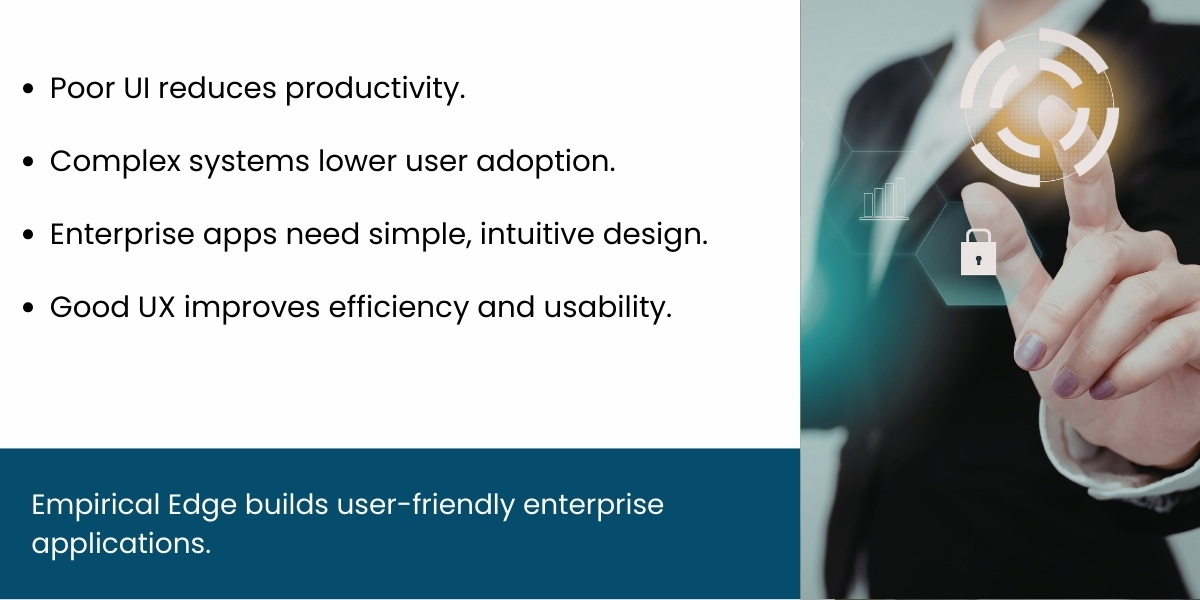
Organizations use Enterprise applications many time a day and across multiple departments. If the User Interface (UI) is complex and or hard to navigate, productivity can be lost, and/or users may choose not to adopt these systems.
Enterprise applications need to provide intuitive UIs and seamless User Experiences (UX). As a result, Empirical Edge focuses on user-friendly designs to help teams be productive and feel comfortable using an enterprise application.
No Scalability Approach
As an organization grows, the business will continue to evolve and therefore the software systems must grow with them. Applications that do not have a Scalable Design cannot easily support growing numbers of users, data, or functionality.
By providing a scalable development approach Empirical Edge provides the opportunity for the enterprise application to provide continuing reliability as the organization grows. Empirical Edge builds enterprise applications using scalable technology and the cloud to maintain long-term growth.
Selecting Inexperience Over Experience to be a Development Partner
Developing enterprise software requires deep technical experience as well as the ability to strategically plan for the future. When an organization chooses to partner with an inexperienced development team, the system can experience delays, decreased performance and ultimately increased costs.
As a result of Empirical Edge’s many years of experience in developing secure, scalable and custom enterprise applications, organizations around the world trust Empirical Edge to provide them with enterprise applications that support the goals of their business.
Build Enterprise Software the Right Way
Avoid costly development mistakes and build enterprise applications that truly support your business goals. Empirical Edge helps organizations design and develop secure, scalable, and high-performance enterprise solutions tailored to their needs.
Frequently Asked Questions
Common mistakes include unclear requirements, poor system architecture, weak security practices, lack of scalability planning, and ignoring system integrations.
Proper planning ensures that the software aligns with business goals, supports user needs, and provides long-term scalability and performance.
Businesses can avoid failures by defining clear requirements, choosing experienced development partners, prioritizing security, and implementing scalable architectures.
System integration allows different software platforms to communicate and share data, improving workflow automation and operational efficiency.
User-friendly interfaces encourage employees to adopt new systems quickly and use them more effectively in their daily work.
Empirical Edge provides scalable, secure, and customized enterprise software solutions that help businesses streamline operations and achieve successful digital transformation.