



With today’s rapid evolution of the digital world, companies must utilize agile, scalable, and secure technology solutions in order to remain competitive. As a result, cloud application development has become an effective means for organizations to innovate faster, decrease infrastructure expenses, and provide seamless scalability.
Cloud-based applications afford the enterprise many advantages with regard to flexibility, performance, and long-term sustainability; they are an excellent choice for organizations that are either transitioning from legacy systems or developing new enterprise platform solutions.
What Is Cloud Application Development
Cloud application development is a methodology for designing, building, deploying and managing software applications that are built and run on cloud computing infrastructures instead of traditional server infrastructures. Cloud applications make use of cloud computing services such as data storage, networking, databases, analytics, and artificial intelligence (AI), to create highly performant and scalable applications.
Unlike traditional software applications, cloud applications can be accessed from virtually any location, automatically update themselves, and allow organizations to scale the number of resources utilized based on their specific needs.
Benefits of Cloud-Based Applications for Enterprises
1. Increased Scalability
With unpredictable workloads, enterprises can easily increase and decrease their infrastructure without having to invest in additional, on-premises hardware by using cloud-based services.
2. Reduced Costs
By using a pay-as-you-go or subscription-based pricing model, companies can eliminate large upfront costs of infrastructure while paying only for what they use in the cloud.
3. Accelerated Time to Market
Using cloud-based environments speeds up development work and allows enterprises to launch products and software updates more quickly through DevOps practices and CI/CD methodologies.
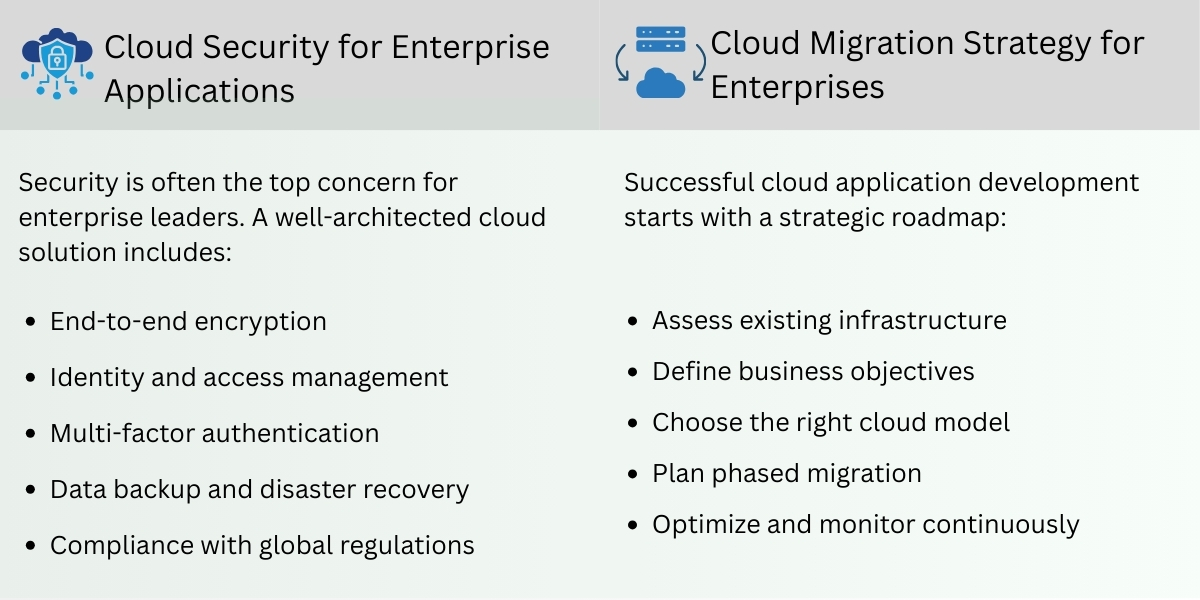
4. Improved Security and Compliance
Cloud providers that serve enterprises typically have enterprise-level security, including encryption and monitoring, and also have various compliance certifications. With proper configuration, cloud environments often provide better security than on-premises servers.
5. Access from Anywhere
Cloud applications enable workgroups located in different geographic locations to collaborate easily. This is a big benefit in a hybrid workforce.
Important Features of Enterprise Cloud-Based Applications
- Multi-tenant security architecture
- Availability and Disasters Recovery
- Microservices-based architecture
- API-driven integration
- Real-time Data Analytics
- Cloud-Native Performance Optimization.
Cloud-Native vs Traditional Application Development
| Traditional Apps | Cloud-Native Apps |
|---|---|
| Fixed infrastructure | Dynamic scaling |
| Manual deployment | Automated CI/CD |
| Limited flexibility | Microservices architecture |
| High maintenance cost | Cost-efficient scaling |
Cloud-native development ensures better performance, resilience, and adaptability for enterprise systems.
Enterprise Use Cases for Cloud Application Development
- ERP modernization
- CRM systems
- E-commerce platforms
- HR management systems
- Healthcare applications
- Financial systems
- Data analytics dashboards
Enterprises across industries leverage cloud solutions to improve operational efficiency and customer experience.
What are the reasons to utilize cloud-based application development services?
The development of enterprise-level software in the cloud requires not only deep technical skillsets, but also thorough architectural knowledge and security expertise. By partnering with a highly skilled (and experienced) developer, enterprise companies can achieve:
- Custom application architecture tailored to your business requirements.
- Smooth transition from legacy system to new application systems.
- Optimization of application performance.
- Application designed with future growth potential.
- Continuity support and maintenance.
A strategic partner in technology helps enterprise companies align their cloud transformation with their business growth strategy.
In conclusion
Enterprise application development utilizing cloud technologies will no longer be optional. Enterprise companies stand a better chance of remaining competitive if they are able to leverage the advantages of cloud application development including; scalability, security, cost efficiency and fast innovation cycles.
Organizations that adopt a cloud-native strategy to develop enterprise applications position themselves for sustainable growth, operational excellence, as well as providing superior customer experiences.
Investing in enterprise cloud applications today will allow you to maintain the required level of resilience and agility needed for your business tomorrow.
Ready to transform your enterprise with secure and scalable cloud applications?
Partner with Empirical Edge to build high-performance cloud solutions tailored to your business goals.
Frequently Asked Questions
It is the process of designing and building scalable software applications that operate on cloud infrastructure for large organizations.
Cloud solutions provide scalability, cost savings, improved security, and faster deployment.
With proper configuration, encryption, and compliance standards, cloud applications offer enterprise-grade security.
Cloud-native apps are built specifically for cloud environments using microservices and automated scaling, while traditional apps rely on fixed infrastructure.
Healthcare, finance, retail, manufacturing, and IT services greatly benefit from scalable cloud solutions.
Written by: Empirical Edge Team