


Organizations have been driven to adopt a scalable healthcare application due to the fact that we have entered into an incredibly fast-paced, rapidly changing digital healthcare world. There are many types of organizations that have created and used a digital platform, from hospitals and private clinics to healthtech startups and telehealth providers within the United States, that depend on a platform capable of supporting their continued growth and success as an organization while maintaining security.
The reason a scalable healthcare application is critical for healthcare providers is that it allows your organization to support more patients, providers, devices and data than ever before while maintaining the same high level of service, performance, security, and reliability as your existing application or service. Below is what all Healthcare Providers Need to Know About Building or Upgrading A Healthcare Application.
The Importance of Scalability for Healthcare Apps
Growth in the healthcare industry can be unpredictable, with unpredictable increases in patient numbers, remote care, integration of wearable devices, and AI-based tools. If your app is not designed to be scalable, it could face performance issues, shutdowns, and lack security, which ultimately affects the quality of care provided to patients.
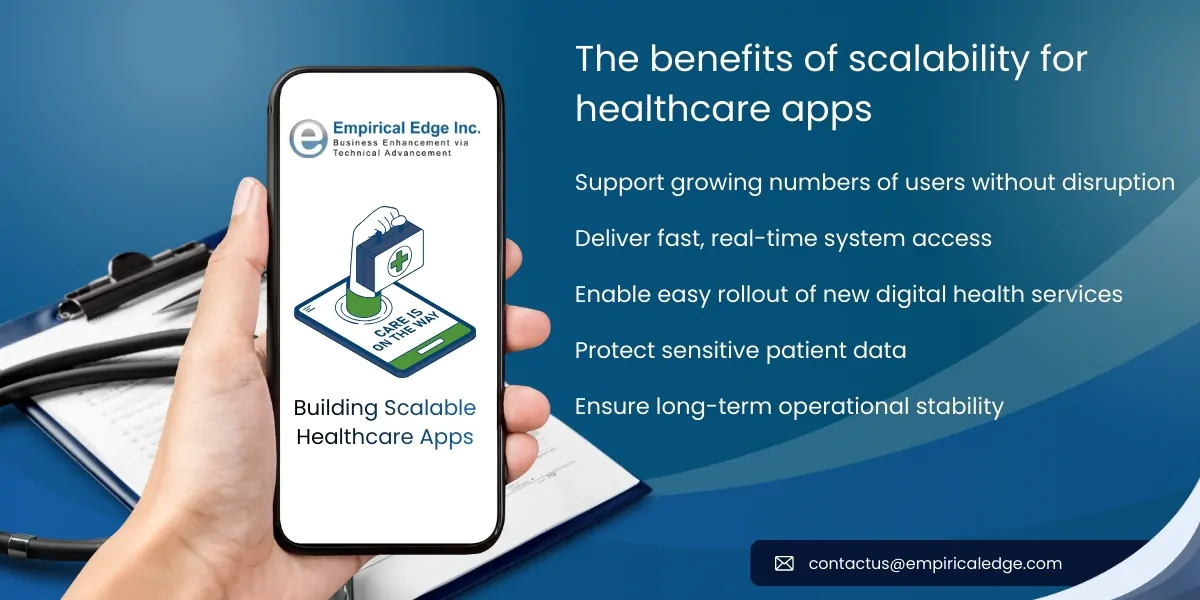
The benefits of scalability for healthcare apps are that they will:
- Provide a steady flow of new users to keep up with demand
- Provide fast and constant access to real-time systems and applications
- Allow for the introduction of new digital health services and applications
- Protect confidential information of patients
- Provide assurance of the ability to operate in the future
Cloud-Based and Scalable Architectures
When developing a healthcare application, use a cloud-based and scalable architecture that can automatically grow according to demand. By using cloud-based technology, hospitals will have the capability to use load balancers, auto-scalers, micro-service architectures, and high availability, which will be critical for a healthcare application that is required to run 24 hours a day, 365 days a year.
Having a scalable architecture allows you to build your healthcare application with the knowledge that it can grow without requiring the entire application to be re-built.
Protecting Data Security for HIPAA compliance
Security is fundamental to your Health Care Platform’s Applications (App). In order for a Healthcare APP (application) to be scalable, it is important to begin construction with a compliant Security Framework.
Essential Security Elements include:
- Data is stored using Encryption and transmitted in an Encrypted State.
- Enhanced Role-based Access
- Compliance with HIPAA
- Monitoring at intervals with Audit Logs
- A secure API’s that remain in compliance with HIPAA
Scalability without Security has Risk; therefore, a Strong Compliance Foundation will protect Patients and Providers.
Expanding User, Device, and Integration Support
Healthcare is Changing Rapidly and Platforms must now provide Support for Health Care Ecosystems Such as the Following:
- Thousands of Users Simultaneously Accessing
- Wearable technology (including IoT Medical Devices)
- Third Party EHR, Billing and Pharmacy Systems
- Mobile and Web APP
- AI-powered Clinical Tools
To Achieve a Scalable Healthcare Application, The APP must be Designed to Integrate with Emerging Technologies Without Affecting The Application Operation of The APP.
Real Time Data Access and Analysis of Patient/Clinical/Operational Data
Real Time Data are Critical to all Health Care Decisions. Therefore, a Scalable Application Must Be Able to Process INSTANTLY Huge Amounts of Patient/Clinical/Operational Data.
Real Time Data Access Will Enable Health care Providers to:
- Monitor Patient Vital Signs Remotely
- Decrease Time to Diagnose and Respond
- Optimize Hospital Operations
- Enhance Preventative Care Strategies
As The Organization Grows, The Scalability of A Scalable Data Pipeline Can Continue to Grow with The Organization.
Design Healthcare Platforms for Maximum Reliability and Performance Over Time
Healthcare providers need to design applications with stability during periods of increased traffic, ideas for future system upgrades, and times when disaster strikes through use of performance engineering, redundant planning, and continuous improvement plans.
For example, reliability over time can mean:
- Few interruptions to service
- Same amount of service under heavy load
- Automatic self-recovery of system
- Continued service enhancement as the quantity of data increases.
Using the correct technological foundation provides an opportunity for the healthcare businesses to grow without any hesitation or disruption.
Why This Matters To Healthcare Providers In The United States:
As a result of many forms of digital pressure in the health care system across the country, including increased use of telehealth, increasing regulation compliance, use of A.I., and growing patient expectation. Building scalar means to provide healthcare provider scalable opportunities for continued growth and increased confidence in providing their patients with high quality digital patient care on a national level.
Conclusion
To develop a scalable healthcare application, it requires more than just adding server capacity. It requires careful design of secure, cloud compatible, high-performance systems which are capable of meeting the evolving healthcare provider needs of the future by utilizing a commitment to the development of scalable architecture and technologies that produces the most comprehensive level of HIPAA compliance, as well as continued use of effective and efficient design forecasting during peak selling periods by the industry.
Build a Scalable, Secure Healthcare Platform That Grows With You
Ready to develop a high-performance healthcare application built for growth, security, and compliance? Partner with Empirical Edge to create scalable healthcare solutions that support real-time data, HIPAA-ready security, and long-term performance across the USA. Let’s build a future-proof healthcare platform together.
Frequently Asked Questions
A scalable healthcare app can handle increasing users, data, and system demands without performance loss or security risks.
Because healthcare systems must support growing patients, real-time data, and integrated services without downtime.
HIPAA compliance, encrypted storage, access controls, secure APIs, and continuous monitoring.
Timelines depend on complexity, integrations, compliance needs, and long-term performance goals.
Written by: Empirical Edge Team