
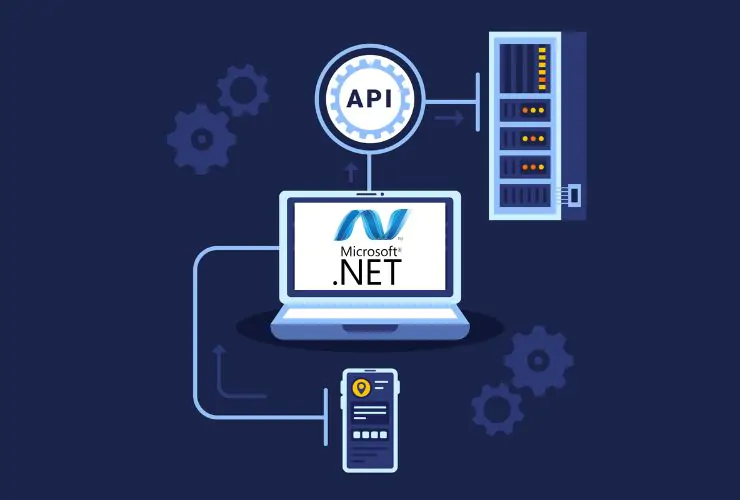



Speed is imperative within the modern digital realm; all current application environments generate a significant volume of HTTP transactions via APIs. Users now expect that responses will be fast, dependable and scalable in response to the number of users accessing an API.
Because of their modular framework and built-in optimization features, ASP.NET Core has quickly emerged as one of the top performing frameworks for creating high-performance APIs and therefore most developers prefer to develop with ASP.NET Core when building APIs.
ASP.NET Core performance optimization tools can substantially enhance performance and scalability for microservices, enterprise or cloud-native solutions.
The following article will highlight the most efficient ways of creating high-performance APIs in ASP.NET Core.
1. Select the Appropriate Hosting Choices
Although ASP.NET Core offers several hosting methods, the superlative host application for ASP.NET Core is the Kestrel web server, because it allows for maximum potential performance through its lack of resource usage and efficient resource management protocols.
Reasons to Use Kestrel
- Asynchronous I/O – Kestrel was architected with asynchronous I/O in mind
- Ability to handle millions of concurrent connections
- Faster than traditional hosting solutions and most server-based alternatives
For production, Kestrel should be subjected to reverse proxies such as Nginx or IIS for both enhanced security and to leverage load balancing capabilities between servers.
2. Route an API Endpoints Using ASP.NET Core’s Endpoint Routing Feature
ASP.NET Core’s Endpoint Routing feature is significantly more efficient than traditional ASP.NET routing.
- Reducing the amount of overhead required to match routes can be accomplished by implementing Attribute Routing.
- Use clean, hierarchal route structures to improve performance.
- Remove any route parameter information that is not absolutely required.
Efficiently routing APIs will result in more efficient CPU utilization, faster response times on requests, and less load on the servers running these APIs.
3. Whenever Possible, Use Asynchronous Programming
Asynchronous programming is the foundation of building high-performance APIs, especially when using async/await, when accessing databases, or when invoking remote web services.
Using Asynchronous Code will allow you to:
- Process more concurrent requests.
- Avoid blocking calls.
- Scale your application under load more effectively.
By default, you should always use the asynchronous versions of all EF Core methods, HttpClient calls, and middleware tasks.
4. Implement Response Caching and Distributed Caching
Cache is the most effective means of improving the performance of an API.
The following types of caching should be utilized within your API:
– Response Caching
This is ideal for APIs that return static or semi-static data.
– In-Memory Caching
This is the fastest and is best suited for single-server implementations.
– Distributed Caching (Redis)
This is required for microservice-based architectures and for APIs that are load-balanced.
Caching reduces database queries, decreases the server’s workload, and significantly increases response times.
5. Optimize Use of Entity Framework Core
Although EF Core has many advantageous features, improperly utilizing it can have negative implications on an API’s overall performance.
Best Practices Include:
- Use AsNoTracking() when performing read-only queries.
- Avoid fetching unnecessary column values.
- Disable Lazy Loading.
- Use Batch Operations.
6. Minimize Middleware Overhead.
Adding middleware to the pipeline also increases the amount of time it takes to process requests.
How To Optimize Middleware:
- Remove Unused Components.
- Place High-Priority Middleware First.
- Avoid Complicated Synchronous Code in Middleware.
Having a Well-Optimized Middleware Pipeline = Faster Request Execution.
7. Implement Gzip/Brotli.
JSON is a primary data format for APIs and has a Very High Compression Ratio.
Advantages Of Gzip/Brotli:
- Reduction In Payload Size
- Saves Time In Transmitting Over The Internet.
- Saves You Bandwidth Costs.
8. Use Data Transfer Objects (DTOs) To Reduce JSON Serialization Time.
The Larger The Model, The Slower It Will Serialize.
Performance Tips:
- Lightweight DTOs.
- No Circular References.
- Enable System.Text.Json For Faster Serialization To JSON (Default In .NET 8).
- Apply The [JsonIgnore] Attribute Where Necessary.
DTO Optimization Improves JSON Serialization And Deserialization Performance.
9. Leverage API Versioning.
API Versioning Makes your API Scalable And Maintainable.
Versioning Types:
- URL Versioning.
- Header Based Versioning.
- Query String Versioning.
Versioning Allows Your API To Evolve Without Impacting Current Users—Especially Important For Long-Running, High-Traffic Systems.
10. Use Health Checks, Logging, And Monitoring.
Monitoring API performance will help identify issues before they affect users.
Tools For Integration:
- ASP.NET Core Health Checks.
- Serilog Provides Structured Logging.
- Application Insights.
- Prometheus And Grafana For Real-Time Application Performance Monitoring.
- OpenTelemetry For Real-Time Application Performance Monitoring.
By Monitoring Your API Real-Time Under Heavy Loads, You Will Have The Ability To Ensure That It Remains Healthy.
11. Deploy Load Balanced & Horizontally Scalable
Scaling is important if you anticipate a large amount of traffic.
Best Practices for Scaling
- Utilize Kubernetes or Docker Swarm for orchestration
- Leverage Azure’s auto-scaling capabilities through App Services
- Distribute your content globally via CDN
- Implement a system for rate limiting
Utilizing horizontal scaling means that your API will be able to quickly scale with traffic spikes.
Conclusion
ASP.NET Core APIs made with a clean architecture, good management of resources, optimized code, and the use of appropriate deployment methods yield highly efficient APIs. Adding techniques such as asynchronous programming, caching, minimal middleware, and efficient queries to the EF Core will allow you to have an incredible and well performing API that is ready for the future.
ASP.NET Core will be one of the leading frameworks for the modern approach to developing APIs and, by optimizing your application, you can create the fastest experiences available and maintain a competitive edge within the digital world.
Frequently Asked Questions
A high-performance API delivers fast response times, handles large traffic loads, processes requests efficiently, ensures minimal downtime, and scales easily as business demand grows.
ASP.NET Core supports asynchronous programming, efficient middleware pipelines, in-memory caching, optimized routing, and native cloud deployment, all of which significantly boost API speed and reliability.
Yes. With proper architecture, load balancing, caching, and cloud deployment, ASP.NET Core APIs can efficiently handle millions of requests and large concurrent users.
Absolutely. ASP.NET Core APIs integrate easily with CRMs, ERPs, mobile apps, cloud services, payment gateways, IoT platforms, and third-party services.
Timelines depend on complexity, features, integrations, and security requirements. Projects can range from a few weeks to several months.
Empirical Edge designs, develops, secures, and optimizes ASP.NET Core APIs that deliver high speed, strong security, and scalable performance tailored to business needs.
Written by: Empirical Edge Team