
Today’s software creation is majorly a part of business strategy (so more than just being part of Computer Services). Companies (SMB through enterprises) in the USA depend on software to grow their businesses, improve customer experience and be competitive. However, there is a low success rate for software development projects, despite all of the investment in developing software.
By understanding why software development projects fail, companies can prevent repeats of such errors and save millions in Project expenses and improve their overall success as digital Businesses.
The Real Cost of Software Failure
When software development fails, the consequences extend beyond financial loss. Businesses face operational disruptions, frustrated customers, damaged reputation, and missed market opportunities.
Poorly executed projects can also delay innovation. In fast-moving industries, being late to market can mean losing competitive advantage permanently.
Top Reasons Businesses Fail at Software Development
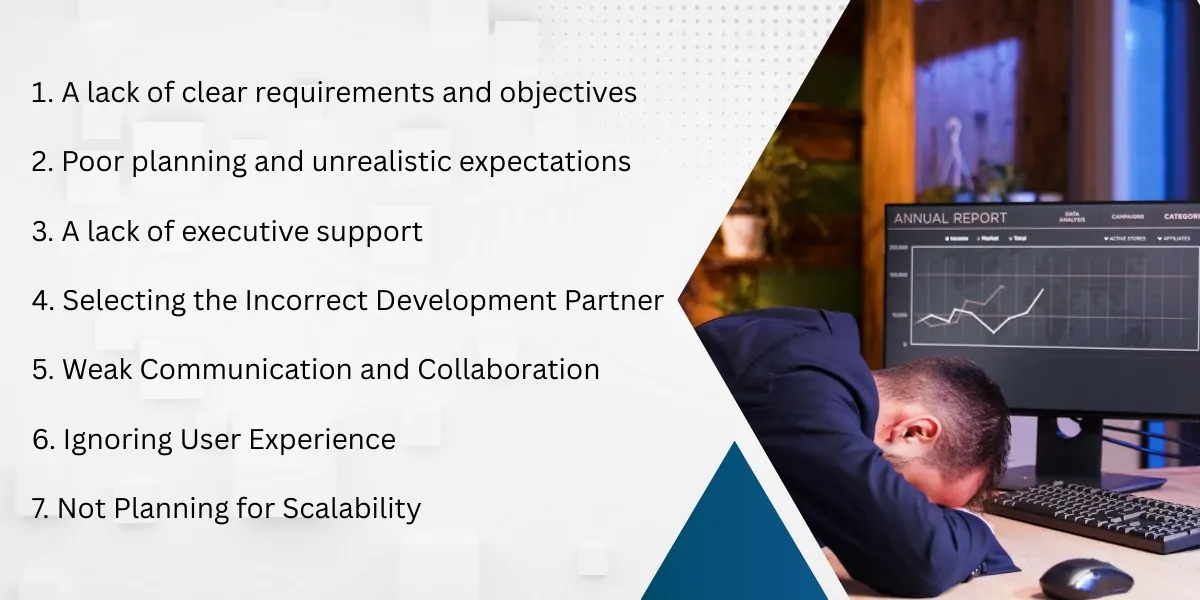
1. A lack of clear requirements and objectives
One of the most common reasons that projects fail is because there are no clearly defined requirements. When there is no agreement between stakeholders on goals, the team ends up developing features that do not actually solve a problem for the business.
Research indicates that incomplete requirements and a lack of user involvement are two of the biggest reasons that projects fail.
How to avoid this:
- Conduct discovery workshops
- Document detailed technical requirements
- Align software goals with the desired business outcomes
2. Poor planning and unrealistic expectations
Many organizations have underestimated the amount of time, money, and complexity of custom software being developed.
Large projects often experience “optimism bias”, where senior leaders believe that everything will go according to schedule (until it doesn’t).
How to avoid this:
- Break large projects into smaller milestones
- Create realistic budgets
- Include contingency buffers in budgets
3. A lack of executive support
Without executive support, software initiatives find it difficult to secure resources, resolve conflict, and maintain momentum.
Stakeholders frequently state that executive sponsorship is a key factor when determining whether or not an IT project is successful.
How to avoid this:
- Assign a project champion from the leadership team
- Ensure that decision-makers remain engaged
- Track KPIs related to business value
4. Selecting the Incorrect Development Partner
When a vendor is selected by price alone it will commonly create issues in the areas of architecture, security, and scalability.
A development team that lacks the experience to build the software properly may successfully build it initially, but it might fail when scaling becomes necessary.
Things You Can Do to Avoid It: Evaluate the technical ability of the vendor and their team. Obtain examples of prior work. Make long term relationships a higher priority than short term savings.
5. Weak Communication and Collaboration
The main cause of scheduling delays and costly rework in development is that communication between project managers and developers is weak or completely missing.
By using frequent collaboration between the stakeholders, developers, and project managers, you can ensure that there is clarity and that the software continues to adapt to business needs.
Things You Can Do to Avoid It: Use an agile communication framework for coordination; schedule weekly status meetings for status checks; maintain transparent communication throughout the process.
6. Ignoring User Experience
A piece of software is often technically capable of working, but still is not usable.
Companies that focus on usability when creating their software typically see a greater level of adoption by the users and a better return on their investment.
Things You Can Do to Avoid It: Start user testing early on in development; create user interfaces that are simple and intuitive; create continuous feedback processes from the user community.
7. Not Planning for Scalability
If you are creating software that only fits your current need, the software will fail under the increased demands when growth occurs.
To be able to grow a business you need to plan for that growth from day one.
Things You Can Do to Avoid It: Select a cloud-native architecture; create modular design for the components of the development; regularly measure performance and create ways to optimize the performance through continuous improvement activities.
Successful Software Development Approaches
Adopt an Agile Approach
By utilizing an iterative development process, organizations can quickly respond to changing conditions and minimize risk.
Agile methodologies allow teams to continually test, learn and enhance until a large release occurs.
Strong Focus on Business Value Instead of Just Features
Organizations with successful businesses are focused on achieving a measurable result (e.g., revenue growth, improved performance, satisfied customers).
Every feature should have a clearly defined answer to the following question:
Will the implementation of this feature have a measurable impact on the business?
Invest in Security and Compliance
As the number of cyber threats continues to grow, insecure applications increase the likelihood of unauthorized individuals gaining access to sensitive organizational data.
Through the proactive application of secure coding within the SDLC, organizations can avoid significant breaches of data and maintain the trust in their brands.
Software is a Long-term Asset
Building software is not a short-term project; once developed, ongoing maintenance, continued development, and modification needs will exist.
Companies who view technology as a strategic investment have a better chance of outperforming their competitors compared to those that view technology as an expense.
How Empirical Edge Inc. Assists Organizations in Avoiding Software Development Failure
Empirical Edge Inc. offers custom software solutions that can be built for scalability and security with a measurable return on investment.
Empirical Edge has established the following relationships with its customers:
- Alignment of Strategic Planning and Business Goals
- Talented development teams with many years of experience
- Execution of a development process based on Agile Principles
- Implementation of enterprise level security standards/controls
- Consistent, open communication
- Support for continued maintenance, development, enhancement, etc.
Rather than just building software, Empirical Edge builds partnership relationships with organizations to deliver the overall digital platform.
Final Thoughts
In most cases, software does not fail because of technology rather it is a consequence of insufficient planning, lack of clarity in strategy, and insufficient collaboration between parties.
The good news is that these risks can be completely avoided.
Companies can transform the way that they view their software from a cost center to an integral driving force of their competitive advantage with the assistance of the right partner, by defining the appropriate objectives, and implementing a plan that allows for scalability.
The businesses that make smart investments today have the potential to dominate their respective markets in the future.
Build Software That Drives Real Business Results
Avoid costly development mistakes by partnering with experts who understand your business goals. Empirical Edge Inc. delivers secure, scalable, and high-performing software tailored for long-term success.
Frequently Asked Questions
Most projects fail due to unclear requirements, poor planning, lack of communication, unrealistic budgets, and choosing inexperienced development partners.
Define clear objectives, adopt agile methodologies, prioritize communication, and partner with an experienced software development company.
Starting development without a well-defined strategy or roadmap often leads to delays, budget overruns, and software that doesn’t meet business needs.
The right partner ensures strong architecture, security, scalability, and alignment with your long-term business goals.
Proper planning helps set realistic timelines, control costs, reduce risks, and ensure the final product delivers measurable value.
Empirical Edge provides strategic consulting, custom development, agile execution, and ongoing support to help businesses build reliable software that scales with their growth.
Written by: Empirical Edge Team