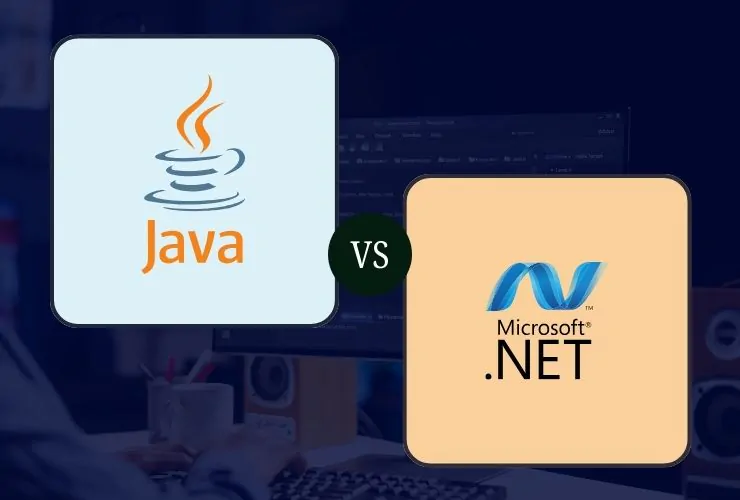



There’s a long list of factors that enterprise software development is concerned with, including the ability for the software to scale, security threats and performance expectations, and how the software will be used over time. The technology stack that is selected to develop the software has a direct impact on the operational performance and maintenance costs of that software, as well as any potential growth opportunities that might become available down the road. The two most recognized platforms for enterprise development, which have been used by virtually all of the top companies across the globe, are Java and .NET.
In this article, we will compare Java and .NET by listing their strengths and weaknesses, as well as the best uses for each of the platforms in order to provide business leaders with the information necessary to choose the right platform for their business.
Java and .NET in the Enterprise Environment
What Is Java?
Java is a versatile object-oriented programming language, designed to let developers create enterprise applications as well as server-side systems, internet applications, and distributed computing solutions. Due to its ability to “write once and run anywhere,” along with its thriving environment for development, Java continues to serve as a foundational piece of enterprise IT.
Java is utilized within a variety of industries including banking, healthcare, e-commerce, telecommunications, and the enterprise-level software as a service (SaaS) space.
What Is .NET?
The .NET Framework is a modern development environment developed by Microsoft that allows developers to build software applications using multiple programming languages such as C#, F#, and VB.NET, but it is also well known for its high-performance, secure, and seamless integration with all Microsoft products. With the introduction of .NET Core and the current versions of .NET, the .NET Framework has expanded to support cross-platform application development across Microsoft Windows, UNIX-based operating systems (Linux), and Apple macOS.
The .NET Framework is commonly used within enterprise web application development, cloud computing, application programming interfaces (APIs), and internal business systems.
Key Factors for Enterprise Development Comparison
1. Performance and Scalability
Both Java and .NET have been optimized to support high-performance enterprise applications.
Java has proven to be an immensely scalable option for enterprises due to the efficient use of the Java Virtual Machine (JVM) and the fact that many companies have successfully deployed very large distributed systems that handle millions of transactions every day on Java.
.NET has made significant improvements in performance in recent years and has reached a level of performance that is superior to many of its competitors. .NET has been able to accomplish this by offering fast execution, effective memory management, and improved run time behavior, especially on cloud-based applications.
Verdict: Although both platforms excel in terms of performance when it comes to enterprise-level applications, .NET is more suited for businesses using Microsoft products and Java is better for companies building large distributed systems.
2. Platform Independency and Ability to Develop in Cross-Platform Environments
Java has embraced the notion of platform independency longer than most of its competitors and therefore, has proven to be a very effective means for enterprises that operate in heterogeneous environments as it runs on any operating system through the use of the JVM.
.NET, a primarily Windows operating system product, has developed strong cross-platform capabilities with the introduction of modern .NET, allowing enterprise applications to run on Linux, Mac OS and Windows.
Verdict: While Java has a significant head start on the competition when it comes to platform independency, .NET has rapidly closed the gap through modern cross-platform capabilities.
3. Frameworks & Ecosystem of Enterprise Application Development
Java has an extensive ecosystem that includes a variety of frameworks used for building enterprise applications such as Spring, Hibernate, and Jakarta EE. These frameworks contain a multitude of powerful tools used in enterprise application development. They also assist with dependency injection, security and microservices.
On the other hand, .NET has a tightly integrated ecosystem that includes ASP.NET, Entity Framework and strong tooling support via Visual Studio. This allows for quicker development cycles as well as consistent application architecture.
Verdict: Java provides a much deeper ecosystem, while .NET provides better integration and streamlining of development within it’s own ecosystem.
4. Business-system Security & Reliability
Security is critical when developing an enterprise system. Java has built its solid reputation in security over many years as the leading development platform for enterprise systems. It has built-in security features such as authentication, encryption, and access control. Those built-in security features have made Java a preferred platform for developers creating enterprise systems in any industry that requires them to comply with various regulatory standards.
.NET also provides enterprise-level security, such as role-based access control, secure authentication mechanisms, and excellent integration with enterprise identity management solutions.
Verdict: Both platforms have strong enterprise-level security features that are ideal for mission-critical enterprise applications.
5. Readiness for Cloud & Microservice-based Architecture
The trend of building Cloud-native applications and adopting a Microservice Architecture is rapidly increasing. Today organizations are meeting the needs of their customers by building multi-tenant Cloud-native applications that make it easy to provide them with Quality Service.
Java is used extensively to build Microservice Applications and Cloud Applications, with the help of technologies such as container technology, Kubernetes and a number of the cloud environments.
.NET also easily connects and integrates with Cloud Application environments – especially Microsoft Azure – and is therefore an ideal choice for organizations that are implementing Cloud-first strategies.
6. Developer Productivity and Tooling
Java has a flexible development model and can be used with a wide variety of tools for developing applications; however, large systems can be difficult to configure due to high complexity.
.NET has strong Integrated Development Environments (IDEs), comprehensive debugging capabilities, and a favorable experience for developers; The result of this combination is often faster application development and easier to maintain applications.
Verdict: .NET generally enables increased Developer Productivity as compared to Java; Java delivers more flexibility and ecosystem options when compared to .NET.
7. Long-Term Support & Community
The Java community continues to be one of the largest in the world and its Long-Term Support (LTS) will deliver reliable environments for Enterprise applications.
The .NET Platform also has an active and growing developer community, is produced and supported by Microsoft, and is updated frequently.
On both Platforms (Java and .NET) there are substantial long-term advantages, stability and innovation continuing in the development of the technology.
When should enterprises use Java?
Java is an ideal platform if you are developing:
- High-Availability Systems which are Large/Distributed
- Systems which need to run on multiple platforms or need to be vendor neutral
- Enterprise applications that have complicated Business Logic.
- The open-source ecosystem with many tools available to assist in developing applications.
When should businesses utilize .NET?
.NET is an ideal choice in the following situations:
- Developing enterprise solutions that are closely integrated with Microsoft products.
- Building cloud-native apps on Azure.
- Employing rapid development with high-quality tooling support.
- Developing scalable APIs, web apps and internal systems.
Conclusion: Java or .NET for enterprise development?
There is no single correct answer for your organization’s particular situation, as there are many factors to consider. Both Java and .NET are powerful platforms (both have been successfully used in enterprises across all industry sectors).
- Java is generally chosen for large-scale, platform-agnostic and highly-distributed systems.
- .NET generally is preferred for increased productivity, modern cloud development and Microsoft-centric enterprise environments.
Which is best may depend on your organization’s business goals, existing business structure, personnel expertise and future strategy.
In summary, both Java and .NET will continue to be among the strongest enterprise development platforms available today. Both provide the scalability, security and reliability your organization will need to support your mission-critical systems. By aligning your platform decision with your organization’s current and future business needs, enterprises can build strong, future-proof applications that will help support ongoing success.
Choosing the right enterprise stack is just the start — we implement it with precision. Our Java and .NET experts are ready to drive your project forward. Start your development journey with us today!
Frequently Asked Questions
Both Java and .NET are excellent for enterprise development. Java is known for platform independence, massive open-source ecosystems, and long-term stability, while .NET excels in performance, cloud integration (especially Azure), and rapid development. The best choice depends on your business goals, existing systems, and scalability needs.
Both Java and .NET are highly scalable and widely used in banking, healthcare, government, and global enterprises. Java offers mature microservices and distributed system frameworks, while .NET provides high-performance services optimized for cloud-native and enterprise workloads.
Today, performance differences are minimal. Both support high-performance APIs, microservices, real-time processing, and large-scale workloads. .NET is often praised for speed and optimization, while Java is valued for stability under massive concurrent loads.
Yes. Empirical Edge provides enterprise consulting, architecture design, modernization services, and full-cycle development in both Java and .NET. We analyze your business needs, infrastructure, scalability goals, and security requirements to recommend and implement the right platform.
Written by: Empirical Edge