



It has become increasingly vital to design software applications that are maintainable, flexible, and easily testable in a contemporary environment. Dependency Injection (DI) is one of the most important patterns that help developers (you) accomplish these goals.
With the introduction of Dependency Injection into .NET Core, developers can now more easily develop applications that are cleanly structured and scale without hindrance from the framework’s architecture.
Various different types of applications such as web APIs and enterprise level software will greatly benefit from DI and help keep your architecture manageable.
This post discusses DI in general, why it exists, how it is implemented in .NET Core, and the positive effect on application quality and performance.
What Is Dependency Injection?
DI is a design pattern that allows a Class to accept (consume) instances of the classes it relies on (known as Dependencies) from a source external to itself, rather than creating them itself. In other words, you (the developer) are encouraged to allow other (external) entities to provide you with the resources your Classes need.
DI enables you to create loosely coupled classes. By loosely coupling your code, it will be easier to maintain and extend your application. In .NET Core, it isn’t just allowed; it is encouraged to use DI to design your applications.
Why DI is Important?
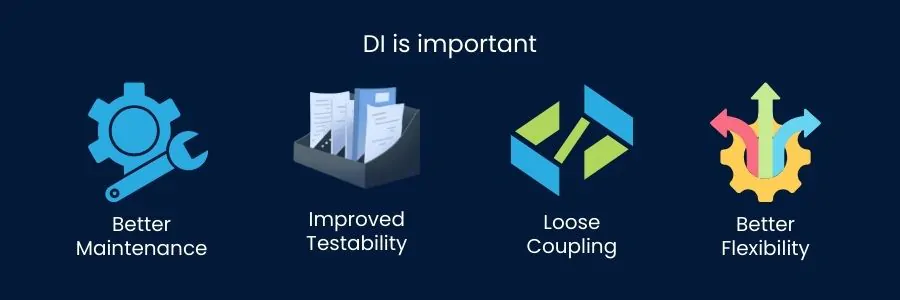
The importance of dependency injection grows as the size and complexity of an application grows. When DI is not used, it typically leads to tightly coupled classes because they create their own dependencies. This can lead to the resulting code being difficult to change because of the way it is structured.
Here is why DI is important:
1) Better Maintenance
The fact that dependencies have been injected rather than created internally means that when one part of the system needs to be changed, it does not lead to breaking other parts of the system. Therefore, modifying and enhancing the system is much easier.
2) Improved Testability
Since DI provides for the ability to easily substitute real dependencies with either mocks or fakes, testing becomes easier. This allows developers to focus on individual components and write more accurate unit tests.
3) Loose Coupling
Loose coupling is one of the core principles of good software design. DI helps to separate responsibilities, which results in cleaner architectures.
4) Better Flexibility
If you need to change the implementation of a specific dependency (such as switching from one logging tool to another), all that needs to be changed is a single piece of configuration rather than updating multiple classes.
5) Cleaner and More Organized Code
DI advocates for the principle of separation of concerns, which makes code cleaner, easier to navigate and modify.
Dependency Injection in .NET core
.NET Core has an official dependency injection framework that is both lightweight and efficient. Developers can utilise the built-in functionality of the framework to register their services and define how the service dependencies will be injected into their classes.
Typically, when using Dependency Injection in .NET Core, the services can be registered with one of the following life cycles:
1. Singleton:
A single instance of the service will be created and used for the entire lifetime of the application. This is typically used for shared configuration values and services that need to have a longer lifespan.
2. Scoped:
A new instance of the service is created each HTTP request made to the application. This lifecycle is typically used for web applications and services that perform user-specific activities.
3. Transient:
A new instance of the service will be created every time the service is accessed. This is often used for lightweight services that do not maintain any state between requests.
By understanding the different life cycles of the Dependency Injection framework, developers can manage their resources properly, avoid memory leaks and unnecessary object creation.
The Role of DI in .NET Core Architecture
Dependency Injection also plays a crucial role in the overall architecture of .NET Core applications. As mentioned previously, .NET Core uses Dependency Injection to automatically inject the required dependencies into the various components of an application including:
- Controllers
- Middleware
- Razor Pages
- SignalR Hubs
- Background Services
- Custom Classes
This architecture allows for each part of an application to receive only the services that it requires while also reducing unnecessary dependencies and simplifying the codebase.
Advantages of Using Dependency Injection in .NET Core
1. Improved Segmentation of Functions
Dependency Injection (DI) removes the burden of both object creation and dependency management from a class that only has a primary function. Therefore, each class has a defined role in fulfilling its particular duty.
2. Consistent Architecture Across the Software Application
DI is built into .NET Core, which creates a unified way to organise how your application is structured throughout its entirety.
3. Less Complicated to Track Errors and Isolate Failures
With DI, you know what the classes are depending upon, and therefore, you are able to easily understand the causes of errors and locate where they originated.
4. Simplified Reusability
A loosely-coupled class allows for the reuse of that class in multiple places within the same application or even in different applications.
5. Optimised Management of Resource Usage and Performance
Utilising the correct DI Lifetime will assist in operating the most effective use of your resources.
The Importance of Dependency Injection in Today’s .NET Core Applications
As more companies move to modern, cloud-oriented applications that are scalable and built out of many smaller parts, Dependency Injection has become an increasingly important part of developing applications with .NET Core. Dependency Injection provides for the following architectural styles in our modern software applications:
- Microservices
- Clean Architecture
- Domain Driven Design (DDD)
- Event-Driven Systems
- RESTful Services
By supporting modularity and flexibility in our applications, Dependency Injection will allow your .NET Core applications to be able to adapt to future growth and maintainability as your organization grows.
Conclusion
Dependency Injection (DI) is a core .NET Core feature that helps build clean, flexible, and scalable applications. DI makes .NET Core apps cleaner, easier to test, and more adaptable as needs evolve. Dependency Injection (DI) simplifies .NET Core development by improving flexibility, testability, and long-term maintainability.
Regardless of whether you are building simple services or full enterprise solutions, it is important that developers understand DI before writing high-quality and scalable .NET Core applications.
Frequently Asked Questions
DI improves code quality, speeds up development, reduces long-term maintenance costs, and makes systems easier to upgrade or scale—helping businesses build stable and future-ready applications.
DI reduces tight coupling between components, making applications easier to optimize, debug, and extend. This leads to fewer system failures, cleaner upgrades, and better performance management.
Absolutely. DI is a core best practice when refactoring legacy systems. It allows teams to replace or upgrade modules without rewriting the entire system—ideal for cloud migration and enterprise modernization.
DI simplifies testing, speeds up feature development, and reduces system dependencies. This results in faster updates, fewer bugs, and lower long-term support costs.
Empirical Edge designs and implements scalable .NET Core architectures using best-practice Dependency Injection, helping businesses build secure, high-performance, and future-ready applications.
Written by: Empirical Edge Team